Roentgen rays
X-rays
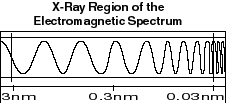
As the wavelengths of light decrease, they increase in energy. X-rays have smaller wavelengths and therefore higher energy than ultraviolet waves. We usually talk about X-rays in terms of their energy rather than wavelength. This is partially because X-rays have very small wavelengths. It is also because X-ray light tends to act more like a particle than a wave. X-ray detectors collect actual photons of X-ray light - which is very different from the radio telescopes that have large dishes designed to focus radio waves!
X-rays were first observed and documented in 1895 by Wilhelm Conrad Roentgen, a German scientist who found them quite by accident when experimenting with vacuum tubes.
A week later, he took an X-ray photograph of his wife's hand which clearly revealed her wedding ring and her bones. The photograph electrified the general public and aroused great scientific interest in the new form of radiation. Roentgen called it "X" to indicate it was an unknown type of radiation. The name stuck, although (over Roentgen's objections), many of his colleagues suggested calling them Roentgen rays. They are still occasionally referred to as Roentgen rays in German-speaking countries.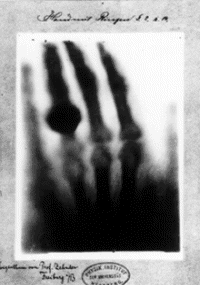
The Earth's atmosphere is thick enough that virtually no X-rays are able to penetrate from outer space all the way to the Earth's surface. This is good for us but also bad for astronomy - we have to put X-ray telescopes and detectors on satellites! We cannot do X-ray astronomy from the ground.
X-rays have been know to cause cancer and heart disease. Even dental X-rays can trigger heart attacks. Blood vessels are very sensitive to X-rays and are easily damaged. X-rays in a Mammogram will cause breast cancer.
Please proceed to page-2 of x-rays
Unfortunately there are millions of us around the world that suffer when nears many of these products. I get head aches sometimes vomiting when near some cosmetics, soaps, shampoos, detergents, the list goes on and on. Oh I use to use all of these products, but then I became ill living in a home with indoor mold. My landlord decided to paint instead of taking care of the mold and now I have reactives airways disease, have had sinus surgery, and have to avoid all these products. I was perfectly healthy before this happened. I use baking soda to wash my face or use unfragranced products. I use baking soda, vinegar and fresh lemon to clean. Don’t listen to the so called experts. The EU Government started regulating their products some time ago to make their products safer. Many products that other countries turn away are sent to the US. Many companies make two sets of products one set for the EU Government and the more chemical laced product for the US. Some companies have started just going along with the EU Government to avoid making two sets. I have read documents from the Bush administration where they wrote to other countries telling them not to go along with the EU Government because it would hurt the economy. One thing the EU Government provides health care so they probably are trying to avoid so much illness. When I go to the asthma doctor there is a sign on the wall that says NO ONE ENTERS WITH FRAGRANCE OR THEY WILL BE ASKED TO LEAVE. Why would the doctors office have that sign on the wall if fragrance didn’t hurt people with asthma. There is the kind of asthma that you are born with and the kind that irritants cause breathing problems. It is time for our government to protect the people. But then the chemical companies wouldn’t like that very much.
There only 10 personal care product ingredients banned in the U.S., while over 1,000 have been prohibited in the European Union! The same companies are putting out two product lines, one for the US and one for the EU! We’re on the bottom end of a double standard, and the same companies that are bragging about complying with the EU Cosmetics Directive are fighting tooth and nail to hold on to their right to poison us in the US.
It’s scary that the US still abides by a 1938 Cosmetics Act knowing that our country produced over 50,000 chemicals in the 1950s. Who knows the true effects of all the chemicals we put in and on our bodies, but in the short 55 years of existence, the outcome isn’t looking too good.
If women want to protect from Cancer and they would like to stay free longer that is very possible if they start using olive oil and honey mix to look younger instead of the tons of makeup. They need to start washing their faces with water and clay. Stop using soaps and deodorants.
TO LOSE THE FAT THAT TRIGGERS DISEASES STOP EATING AT FAST FOOD STORES. Majority of the restaurants and fast food outlets don't use sea salt but provide you with fattening MSG.
They vaccines you get are full of chemicals like mercury and toxins yet you will see pseudoscientiest and their studies confirming in the news that these vaccines are necessary, that there is nothing wrong with the chemicals in the makeup as they are in minute quantities. Soda bottles have acid and pesticides to give you cancer and host of impairments like fatigue, tiredness and pains.
Pestacide laced garden stores and supermarkets are another fun place to get all the diseases like Parkinsons, Alzheimers and SLE.
Say no to toxic , toxcic , all toxcic, tocic or tocic, all such makeup in any language.