How do we "see" using X-ray light?
What would it be like to see X-rays? Well, we wouldn't be able to see through people's clothes, no matter what the ads for X-ray glasses tell us! If we could see X-rays, we could see things that either emit X-rays or halt their transmission. Our eyes would be like the X-ray film used in hospitals or dentist's offices. X-ray film "sees" X-rays, like the ones that travel through your skin. It also sees shadows left by things that the X-rays can't travel through (like bones or metal).
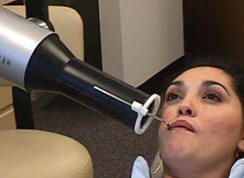  | When you get an X-ray taken at a hospital, X-ray sensitive film is put on one side of your body, and X-rays are shot through you. At a dentist, the film is put inside your mouth, on one side of your teeth, and X-rays are shot through your jaw, just like in this picture. It doesn't hurt at all - you can't feel X-rays. |
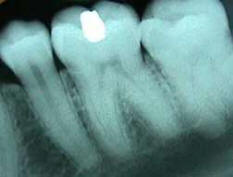 | Because your bones and teeth are dense and absorb more X-rays then your skin does, silhouettes of your bones or teeth are left on the X-ray film while your skin appears transparent. Metal absorbs even more X-rays - can you see the filling in the image of the tooth? |
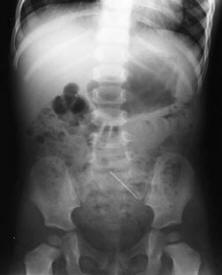 | When the Sun shines on us at a certain angle, our shadow is projected onto the ground. Similarly, when X-ray light shines on us, it goes through our skin, but allows shadows of our bones to be projected onto and captured by film. This is an X-ray photo of a one year old girl. Can you see the shadow of what she swallowed? |
We use satellites with X-ray detectors on them to do X-ray astronomy. In astronomy, things that emit X-rays (for example, black holes) are like the dentist's X-ray machine, and the detector on the satellite is like the X-ray film. X-ray detectors collect individual X-rays (photons of X-ray light) and things like the number of photons collected, the energy of the photons collected, or how fast the photons are detected, can tell us things about the object that is emitting them.
To the right is an image of a real X-ray detector. This instrument is called the Proportional Counter Array and it is on the Rossi X-ray Timing Explorer (RXTE) satellite. It looks very different from anything you might see at a dentist's office! | 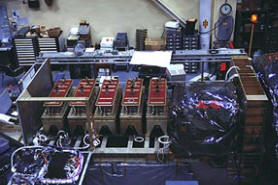 |
Continue to next page