Pathalogy in CIDP and autoimmune diseases


      Home
     Diagnosis
     Treatment
     Pathology
     Variants
     CIDP info
     GBS
      IVIG
      Diet
      About Us
      Contact
      Email Web Weaver
      Autoimmune diseases
      News
      Links
  Chronic fatigue syndrome


makeup

Clinics of Excellence
  Skin repair Clinic
  Neck Pain
  Rabinder N Tagore
  Breast Lymph Drainage
  Osteoporosis
  Electronic Treatment
  Breast Size & Disease
  Female Sex Disease
  PARKINSON
  Memory problems
  Breast Lymph Drainage
  Kidney stone Buster
 Bras cause breast cancer
  Lahore Clinic
  Lahore skin Clinic
  Pandas


  Clinics of Excellence

 Female sexual problems

Breast size and disease

Breast Lymph drainage

Bras causing breast cancer

Breast Size and disease


             Derma
 
 
         antibiotics

 Want more sex

 Vitiligo 1

  Vitiligo 2


Eliminate risk of heart disease & stroke 

Memory clinic

Depression & anxiety

Private treatment of addiction  & Drug Rehab

Sexual  disorders Clinic

Parkinson Clinic

Epilepsy Clinic

Pain Clinic

Bone disorders clinic

Joint disorder clinic

Skin repair clinic

Gene Manipulation

Neurology Clinic

TMJ CLINIC

We offer a lecture on personality development and self improvement.


Is your teenage child out of your control we do behavior modification treatment with positive results and a 90% turnaround.

Our Nanoparticle treatment units are for sale. Get your treatment at home.

Sex in autoimmune disease

Reduce weight

Drug reaction prevention

Prevent Osteoporosis

Some rheumatic disorders

Personality

Alopecia treatment

Bald Facts

Alopecia

Areata Alopecia

Hair chemicals

Hair Growth

Hair of dog technique

Hair rejuvination

Alopecia general

Nail Fungus

SESAME SEED OIL

Facial  cleaner

oil pulling


Parkinso

                                      Welcome to the  Pathology Page  section of the CIDPUSA web site. Number 1 site on autoimmune diseases on Planet Earth

                                     Internet based  Medical help  Available at our Lahore Facility contact us
    For detailed info on diagnosis, prevention  & treatment of autoimmune diseases see the , "Flame within contents".


Google Groups Subscribe to cidpusa
Email:
Browse Archives at groups.google.com

 Click here to see the rate of conduction in human nerve fibers.                                                                                         Printer Friendly Page

     The cause of autoimmune disease is uncontrolled inflammation, this inflammatory reaction in limited to a particular group of cells only. In alzheiners the neurons in the brain are affected. In Thyroditis the thyroid gland is inflamed. In vasculitis the blood vessels are inflamed. In Fibromyalgia the fibrous covering around the muscles is affected. In CIDP & Multiple Sclerosis the  Myelin around the nerves is a target and destruction of Myelin

If you are wondering what is inflammation. The answer is all of us have a built in protective force or army called the immune system. In rare cases a invader comes (bacteria, bug, virus, chemical) . This invader will induce a immune attack, in some invaders proteins resemble the human tissue. Any attack that takes place on the invader will mistakenly attack similar  human tissue. That is a autoimmune inflammatory  disease.

Each cell in our body is programmed to live for a certain time. They will perform cellular suicide when the time comes. Our antiageing treatments are based on re programming the cycle of aptosis.

 In CIDP our own Immune System turns on to attack the Myelin around the nerves. If the attack is on peripheral Myelin around the nerves in arms and legs it is called CIDP or Guilliane Barre Syndrome.  If the attack is targeting central Myelin located in the brain or spinal cord then the diseases is called Multiple Sclerosis. Suppose the attack is against both central and peripheral Myelin  then the disease it will be called ALS or Lugaric disease. In CIDP nerves can be attacked in any part of the body, eye, ears, throat, stomach, heart but the treatment remains the same.

The treatments that CIDPUSA recommends are simple and inexpensive, directed against the attacking organism in the particular disease. All the treatments are available in our autoimmune E.Book, " the flame within".  The treatments are from University studies all over the world. No medical center in the Western world is aware of all these treatments. A few specialty clinics in the USA do offer these treatments in the field of rheumatology. Nanotech Lahore facility became the first Medical center to adopt all these treatments. cIf you need the name of the clinics which practice these methods please contact us , we do charge $10 TO GIVE YOU THE NAMES OF THOSE DOCTORS.

 W e have written complete treatment guidelines of all autoimmune disorders in our E-Book .

         Chronic Inflammatory Demyelinating  Polyradiculoneuropa   

                                      What is  Autoimmunity:

Autoimmune disease occurs when the immune system initiates a specific  response against a self protein .  The response of the immune system is misdirected and results usually after exposure to infecting organisms or chemical toxins. Autoimmune diseases result from a dysfunction of the immune system in which the body attacks its own organs, tissues, and cells. Physicians and scientists have identified more than 80 clinically distinct autoimmune diseases. Several are well known, including rheumatoid arthritis, multiple sclerosis, type 1 diabetes, and systemic lupus erythematosus; others are less familiar, including autoimmune hepatitis, Sjögren’s syndrome, autoimmune ear disease, and pemphigus. Collectively, these diseases afflict millions of Americans, an estimated 5 to 8 percent of the population – 14 to 22 million persons. The social and financial burdens imposed by these chronic, debilitating diseases include poor quality of life, high health care costs, and substantial loss of productivity. We have calculated that autoimmune diseases is the number one diseases process in the world, the main cause of ageing and the number one killer of animals and humans on planet earth.

CIDPUSA has done 20 years of research and produced a autoimmune diseases prevention e-book our Bestseller.

Written by Dr Imran Khan


                                                                       Introduction to CIDP:

CIDP is an autoimmune disease, which affects the motor and sensory nerves by destroying the myelin sheaths surrounding the nerves. The myelin sheath is a fatty covering acting as an (insulator which helps conduction) to the fibers of nerves. Myelin wraps around the axon and helps electrical current flow down the axon (just like wrapping tape around a leaky water hose would help water flow down the hose).


Above is a illustration of how Myelin is wrapped around the axon. This protects the axon and helps in electrical conduction in the nerve. Below is an example of how electrical impulses travel in a nerve.

However, the myelin insulation does not cover the entire axon. Rather there are breaks in the wrapping. These breaks are called nodes of Ranvier. The distance between these nodes is between 0.2 and 2 mm. Action potentials traveling down the axon "jump" from node to node. This is called saltatory conduction which means "to leap". Saltatory conduction is a faster way to travel down an axon than traveling in an axon without myelin

See a example of salutatory conduction shockwave needed. (opens in a new window).

See a video of conduction in a nerve. (opens in a new window


Saltatory conduction.  Nerve impulses move quickly  by jumping from node to node.  When portions of the myelin sheath are destroyed, the message must travel via the axon which is less efficient and slower as compared to the jumping currents of salutatory conduction.

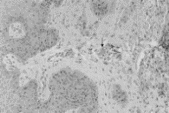
   Myelin sheath under a microscope. Other then CIDP & GBS, Polio & Leprosy damages myelin in peripheral nervous system .
Multiple sclerosis damages myelin in the central nervous system. Schwann cell makes myelin in the PNS (Nerves). Oligodendrocyte makes myelin in the CNS (Brain).

Without this covering, nerves lose the ability to transmit electrical impulses from the brain to the muscles. There is  evidence that the inflammation of this neural tissue is caused  by the autoimmune process to the sheath of the nerves. CIDP is thought to be the chronic variety of Guillain-Barre Syndrome (GBS). There are two types of CIDP: chronic progressive, and relapsing. In chronic progressive patients, the disease gradually worsens over time. Relapsing patients show recurrent attacks with some improvement between attacks.

This disease is characterized by progressive weakness and loss of neurological function  in the legs and arms. Most patients with this disorder present with a case of progressive weakness for  months. The course of the disease is characterized by periods of relapses and remissions. CIDP is slightly more prevalent in young adults, it can occur at any age, and statistics show that men are twice as likely as women to contract this disease. Some typical symptoms include: symmetric tingling in the proximal and distal extremities, weakness or paralysis of the muscles. The onset is gradual over the course of at least 8 weeks. Statistics show that 70% of patients diagnosed with CIDP presented with  only sensory symptoms later developed motor symptoms over the course of 2-3 years.                                        


Figure 2: This figure shows a representation of a demyelinated nerve

A. Demyelination at the paranodal region (solid arrow). Arrow head points to the node of Ranvier.

B. Demyelination of a nerve segment (solid arrow) between the two nodes of Ranvier (arrow heads). This finding is frequently observed in the nerve biopsy of CIDP.


How is it related to the immune system?

The main reason CIDP is considered an immune disorder is that it because inflammation is seen in the nerve tissue, anti inflammatory treatment helps this condition. It is very difficult to diagnose and can be diagnosed through a number of methods which are discussed below. Although the etiology remains unknown, both humoral and cell-mediated immune mechanisms contribute to the pathogenesis. Immune or inflammatory mechanisms are thought to be the root cause of many disorders that, like CIDP, reflect damage to the peripheral nerves and affect sensory function. This turns out to be the most definite role of the immune system in the development of CIDP; the mutation of the macrophage to cause macrophage-mediated inflammation, ultimately resulting in the demyelination of the nerves.
Another characteristic of CIDP, which leads to its classification as an autoimmune disorder, is the evidence of preexisting infections immediately prior to the development of the disease in a significant number of patients. Studies show that in 70% of GBS patients (Guillain-Barre Syndrome), the acute form of CIDP, have pre-existing infections prior to the development of symptoms. Although the pathology of the infections preceding CIDP are studied less frequently, statistics show that at the very least relapses are strongly correlated with infection .

The specific pathway for induction of the autoimmunity associated with CIDP is unknown. The current research cannot eliminate the possibility of an antibody mediated self-reactivity or a T-cell mediated self reactivity. The possibility that infection is a possible stimulus to the development of CIDP can support either pathway. Infections are capable of inducing co-stimulatory activity on antigen presenting cells that present low levels of the specific peptide being attacked, in this case myelin. Another pathway is that of molecular mimicry. In this situation, antibodies or T-cells generated in response to an infectious agent cross-react with self antigens. A molecular mimic is a foreign antigen closely related in structure to a self peptide allowing an antibody mediated response mounted toward the mimicked peptide to also effect the self-protein .


What components of the immune system are involved?

T-Cells:

The most widely explained mechanism for the demyelination of nerve cells in CIDP is a macrophage-mediated inflammatory response. Endoneurial inflammatory changes with T cell infiltrates and macrophage associated demyelination are present on nerve biopsies in patients in the acute phase of CIDP (Mahad, et al, 2002). These endoneurial lymphocytes are associated with the increase expression of mRNA for Tumor Necrosis Factor alpha (TNF alpha), Interferon gamma (INF gamma) and Interluekin-2 (IL-2) (Mahad, et al, 2002).. TNF alpha is involved in local inflammation and endothelial activation. INF gamma causes macrophage activation, increased expression of MHC molecules and Ig class switching. INF gamma also suppresses the less damaging TH2 response in favor of the inflammation mediation of TH1. IL-2 is a crucial chemokines for the adaptive immune response and aids in the proliferation of T-cells. All of these proteins are either produced by T-cells, Natural Killer Cells or Macrophages, or add to the existence of T-cells and cause the initial inflammatory response associated with infection (Janeway, 2001). Activated T lymphocytes are increased in the peripheral blood of CIDP patients. This diagnostic evidence coupled with the relative success of T-cell suppressive treatment makes the case for a possible malfunction in the TH1 inflammatory response.

Antibodies and Complement:

These components of the immune system play a role in the pathogenesis of CIDP in the presence of a blood-nerve barrier breakdown. (after the demyelination has begun)

The current research debates whether CIDP is associated with a specific antibody response against neural antigens (van Doorn, 2000). Antibodies against selected neuroblastoma cells have been found in 40% of patients with CIDP and GBS in comparison with only 4% in other neuropathies (van Doorn, 2000). This, however, is far from conclusive as to the direct pathology of the disease, as other groups show no antibody interaction with myelin proteins or glycolipid cell-surface receptors (van Doorn, 2000).

Some forms of CIDP can be diagnosed using autoantibody serums to tubulin. Tubulin is a molecule which mediates many cell processes specifically cell division and movement of materials within cells. The suggested mechanism for the autoantibody to tubulin involves both IgG and IgM antibodies capable of binding to the tubulin epitope. This pathology was present in 10% of patients with CIDP (Washington University, 2003).

Another specific immunologic interference occurring in 26% of patients with CIDP is an interaction between IgG antibodies and Schwann cell processes. Schwann cells are the cells that wrap themselves around nerves making a protective barrier for the nerve fibers. Schwann cells are the individual cells making up the myelin protective sheaths. This suggests that a patient presenting with symptoms of CIDP could possibly have an autoantibody response against cell schwann cells. This response tags the self-protein for natural killer cell destruction.


            CIDPUSA
    www.cidpusa.org  www.cidpusa.org/P/ivig.htm  http://www.cidpusa.org/disease.html http://www.cidpusa.org/Lahore.html