CidpUsa.Org
Autoimmune Diseases Web
Overview: Temporal Arteritis
(Giant Cell Arteritis) can make
you Blind
Treatment consists of intravenous immunoglobulin (IVIg)
Axonal Polyneuropathy changes in EMG
EMG/NCV section
Learn about the Brain
EMG PAGE
Historical Aspects of Lower Motor Neuron Syndromes
- The original descriptions of pure motor syndromes without upper motor neuron signs were probably cases of "progressive muscular atrophy" in the writings of Duchenne, Aran and others during the 19th century . Benign, focal motor neuron disorders, such as monomelic amyotrophy, were subsequently reported . These syndromes were usually considered as variants of ALS, as early pathological studies suggested that the primary focus of the disease was on cell bodies in the ventral horn.
A pathological report by Rowland et al. first documented that a patient with a pure motor syndrome could have the primary site of disease along the course of the axon. This patient, with a lower motor neuron (LMN) syndrome and a serum IgM M-protein, had damage to motor axons but not cell bodies. Motor neuropathies were first diagnosed during life by electrodiagnostic testing. Nerve conduction studies showed blockade of impulses at focal sites along the course of motor axons (motor conduction block) . The phenomenon of conduction block had been described earlier in patients with sensory-motor neuropathies (chronic inflammatory demyelinating polyneuropathy (CIDP)) . Conduction block results from focal regions of immune-mediated demyelination along the course of the nerve.
In 1986 a patient was reported with a LMN syndrome without conduction block, but with a serum IgM M-protein that bound to GM1 ganglioside. In this instance the association of the motor syndrome with an autoantibody directed against a neural antigen suggested that the disorder might be immune-mediated. However, attempts at immunosuppression had no effect on the progressive disease in that patient. A clinical response to immunotherapy remains a "gold standard", without which it is difficult to argue that a syndrome is immune mediated. In 1988 two patients with a multifocal motor neuropathy, motor conduction block, and serum IgM anti-GM1 antibodies were reported to improve after treatment with cyclophosphamide . It now appears that either motor conduction block or serum anti-GM1 antibodies alone can be markers for patients with LMN syndromes that often improve after immunomodulating therapy.
continue to nerve speed page
Signs and SymptomsPatients with temporal arteritis usually notice visual symptoms in one eye at first, but as many as 50% may notice symptoms in the fellow eye within days if the condition is untreated.
Headache
- Tenderness of scalp (combing hair may be painful)
- Pain in temple area (may be excruciating)
Transient blurred vision
Loss of appetite
Fever
Fatigue
Depression
Drooping lid
Double vision
Sore neck
Jaw soreness, especially when chewing food
-
Detection and DiagnosisLooking in the Fundus of the EYE
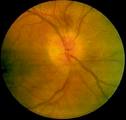 You see a pale disc in the center
When temporal arteritis is suspected, the doctor will order blood tests including a erythrocyte (red blood cell) sedimentation rate (ESR) and C-reactive protein test. The the erythrocytes to collect in the bottom of a test tube. The sediment layer of erythrocytes is measured in millimeters and recorded. An abnormally high ESR is indicative of active inflammation.
Please go to next page of treatment of Temporal arteritis