For a complete simple guide on complete
treatment of autoimmune disease by alternatives please read our
e-book
See services link for
help and contact information. Use the search below for any answer
Loading
CIDP
& MUSCLE DISEASE part-2
Comment
This
case
illustrates
a
discrepancy
between
the
raised
ESR
and
normal
CRP.
This
pattern
is
found
frequently
in
patients
with
inflammatory
muscle
disease
as
well
as
in
other
connective
tissue
disorders
such
as
systemic
lupus
erythematosus.
In
this
case
we
feel
that
the
ESR
reflects
the
underlying
severity
of
muscle
disease,
which
was
also
reflected
by
the
very
high
CK.
However,
the
ESR
is
not
always
a
reliable
marker
of
disease
activity
in
inflammatory
muscle
disease,
and
indeed
in
our
series
was
not
elevated
in
approximately
50%
of
cases
at
presentation.
Severe
myositis,
as
evidenced
by
the
CK,
does
not
necessarily
imply
diffuse
myositis,
as
demonstrated
in
this
case
by
the
MRI.
Indeed
a
patchy
distribution
on
MRI
is
characteristic
of
these
diseases,
and
explains
why
a
normal
muscle
biopsy
is
not
incompatible
with
severe
disease.
The
lack
of
inflammatory
cells
in
the
muscle
biopsy
in
this
case
may
also
be
due
to
the
vasculitic
basis
of
dermatomyositis,
leading
to
ischaemic
muscle
necrosis
[1–3].
In
other
situations
a
normal
biopsy
may
result
from
steroid
treatment.
However,
in
this
case,
central
nucleation
is a
feature
of
regenerating
muscle
fibres,
and
therefore
demonstrates
an
active
pathological
state.
In
our
series
of
78
patients,
23
(29%)
had
pharyngeal
or
oesophageal
involvement.
Intravenous
Ig
was
used
to
treat
dysphagia
in
the
four
most
severe
cases,
with
complete
recovery
occurring
in
all,
including
the
case
described.
Cyclosporin
was
used
in
this
case
rather
than
azathioprine
as
it
is
available
in
liquid
form
and
is
therefore
more
convenient
for
long‐term
use
in
patients
with
a
PEG
tube.
This
case
illustrates
the
point
that
patients
may
need
two
or
more
courses
of
i.v.
Ig
before
they
regain
normal
swallowing.
The
use
of
i.v.
Ig
is
discussed
in
detail
in
the
Discussion.
A
51‐yr‐old
African
woman
presented
with
a
3‐month
history
of
facial
swelling,
tenderness
and
weakness
of
the
upper
arms
and
thighs,
and
difficulty
swallowing.
On
examination
there
was
periorbital
oedema
and
considerable
proximal
muscle
weakness.
The
serum
total
CK
was
8585 U/l,
ESR
35 mm/h
and
no
autoantibodies
including
ANA
and
Jo‐1
were
present.
An
EMG
showed
patchy
low‐amplitude
polyphasic
potentials
and
a
full
interference
pattern
in
keeping
with
a
myopathic
process.
Muscle
biopsy
from
the
thigh
was
normal.
Barium
swallow
and
echocardiogram
were
normal.
The
features
were
characteristic
of
dermatomyositis.
Following
initial
treatment
with
prednisolone
and
azathioprine
the
weakness
slowly
improved
and
the
serum
CK
fell
to
98 U/l.
Prednisolone
was
successfully
tapered
to a
low
dose
and
she
remained
well.
Three
years
later
she
developed
calcinosis
in
the
tissues
of
her
buttocks
and
upper
arms
and
a
skin
biopsy
revealed
vasculitis
(Fig. 1⇔).
A
year
later
she
relapsed,
became
weak,
the
ESR
rose
to
58 mm/h
and
the
CK
remained
normal.
An
MRI
of
both
thighs
showed
patchy
increased
signal
on
inversion
recovery
images,
and
muscle
biopsy
from
the
thigh
revealed
basophilic
fibres
with
lymphocytic
infiltration.
At
the
same
time
she
developed
ataxia
and
dizziness,
and
an
MRI
of
the
brain
revealed
a
left
cerebellar
hemisphere
infarct
(Fig. 2⇔),
which
was
presumed
to
be
due
to
vasculitis.
She
received
two
courses
of
i.v.
Ig
(2 g/kg)
resulting
in
an
improvement
in
muscle
weakness;
and
dizziness
resolved
spontaneously.
The
calcinosis
was
treated
with
diltiazem,
up
to
360 mg
daily,
but
did
not
diminish.
Comment
The
ESR
at
presentation
was
not
as
high
as
might
be
expected
from
the
CK,
and
this
illustrates
our
comments
after
case
1
regarding
the
ESR
in
inflammatory
muscle
diseases.
The
initial
muscle
biopsy
from
this
patient
was
normal.
This
reflects
the
patchy
nature
of
the
myositis
as
shown
subsequently
in
this
patient
on
muscle
MRI,
and
confirmed
on
the
second
biopsy.
Basophilic
fibres
indicate
regenerating
muscle
and
this
is a
feature
of
an
active
pathological
state.
The
diagnosis
of
relapse
was
not
supported
by
the
CK
but
was
clearly
demonstrated
by
the
MRI
and
biopsy.
The
role
of
MRI
in
long‐term
management
is
discussed
in
detail
in
the
Discussion.
Calcinosis
is a
feature
of
dermatomyositis
that
is
more
frequently
recognized
in
children.
We
have
one
other
adult
case
of
dermatomyositis
with
calcinosis
in
our
series,
in
which,
in
contrast
to
this
report,
the
calcinosis
improved
considerably
following
treatment
with
the
calcium
channel
blocker
diltiazem.
The
primary
pathological
process
in
dermatomyositis
is
vasculitis
within
skeletal
muscle
,
and
is
demonstrated
in
this
case
in
the
skin
biopsy.
Systemic
vasculitis
is
also
reported,
but
involvement
of
the
central
nervous
system
(CNS)
is
rare
and
more
classically
described
in
children
. In
this
case
the
appearances
on
the
MRI
were
of
ischaemia,
which,
in
the
absence
of
risk
factors
for
thromboembolic
disease,
we
feel
was
most
likely
to
be
due
to
vasculitis.
We
have
seven
other
cases
of
systemic
vasculitis
in
our
series
(9%),
and
one
other
case
of
CNS
vasculitis,
all
in
patients
with
dermatomyositis.
View larger version:
Fig. 1.
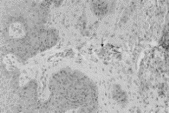
Case 2. Haematoxylin and eosin section of skin showing a florid vasculitis with fibrinoid necrosis (arrow). In addition to the perivascular inflammatory infiltrate there is a diffuse acute inflammatory infiltrate throughout the dermis.
View larger version:
Fig. 2.
Case 2. T2‐weighted MR image of brain showing high signal in the left cerebellar hemisphere in keeping with an area of ischaemia (arrow).
Case
3
Diagnosis:
Fulminating
onset
polymyositis
with
myoglobinuric
renal
failure.
A
22‐yr‐old
Caucasian
man
was
admitted
with
a
short
history
of
fever,
sweats,
loss
of
weight,
muscle
pains
and
weakness.
Before
admission
he
developed
shortness
of
breath,
difficulty
swallowing
and
noticed
that
he
was
passing
dark
urine.
There
was
no
history
of
drug
or
excess
alcohol
consumption.
Examination
revealed
moderately
severe
proximal
muscle
weakness
and
tenderness
but
normal
reflexes
and
sensation.
The
cardiovascular,
respiratory
and
abdominal
systems
were
normal.
Serum
CK
was
>45 000 U/l,
full
blood
count,
urea
and
electrolytes,
ESR
and
CRP
were
normal.
Autoantibodies
including
ANA
and
Jo‐1
were
negative.
Urine
contained
myoglobin.
EMG
showed
numerous,
low‐amplitude,
high‐frequency
complex
motor
units
with
prominent
fibrillation
potentials
and
a
full
interference
pattern
on
maximum
volition
indicating
an
active
myopathic
process.
MRI
showed
extensive
inflammatory
change
in
the
muscles
of
both
thighs
with
relative
sparing
of
semitendinosus,
semimembranosus
and
biceps
femoris
muscles
(Fig. 3⇔).
The
features
were
characteristic
of
fulminant
polymyositis
with
myoglobinuria.
Serial
lung
function
tests
showed
rapid
deterioration
and
he
required
a
tracheostomy
and
ventilation
on
the
intensive
therapy
unit
(ITU).
The
serum
CK
rose
to
148 000 U/l
and
renal
function
deteriorated,
peak
serum
urea
45.1 mmol/l,
creatinine
277 µmol/l,
requiring
haemofiltration
to
remove
myoglobin
from
blood
and
preserve
electrolyte
balance.
He
was
treated
with
i.v.
methylprednisolone
followed
by
oral
prednisolone,
bolus
i.v.
cyclophosphamide
and
i.v.
Ig
at
2 g/kg
over
3
days.
Progress
was
complicated
by
aspiration
resulting
in
staphylococcal
pneumonia
with
a
lung
abscess
and
pneumothorax.
His
muscle
strength
and
bulk
deteriorated
considerably
and
he
received
a
further
course
of
i.v.
Ig
at
2 g/kg
over
3
days.
A
gradual
improvement
in
muscle
strength
followed,
he
was
weaned
off
the
ventilator
but
had
persistent
difficulty
in
swallowing
and
required
a
PEG
tube.
Renal
function
normalized,
serum
CK
fell
to
252 U/l
and
after
2 months
he
was
transferred
from
ITU
to
the
general
wards.
He
had
a
third
course
of
i.v.
Ig
at
2 g/kg
over
3
days
and
over
the
following
month
there
was
sufficient
improvement
in
muscle
strength,
swallowing
and
respiratory
function
to
enable
the
tracheostomy
and
PEG
tubes
to
be
removed.
Over
the
next
year
improvement
in
muscle
strength
continued
with
low‐dose
oral
prednisolone
and
azathioprine.
The
serum
CK
remained
elevated
between
200
and
600 U/l
and
renal
function
tests
remained
normal.
Because
of
abdominal
pain
the
azathioprine
was
changed
to
cyclosporin.
He
has
remained
well,
back
at
full
time
work,
and
has
no
muscle
weakness.
Repeat
MRI
18 months
after
the
initial
presentation
shows
no
acute
inflammation,
but
evidence
of
fatty
change
and
mild
atrophy
(Fig. 4⇔).
Comment
Rhabdomyolysis
with
myoglobinuria
is a
rare
presentation
of
inflammatory
muscle
disease.
However,
in
our
series
this
has
been
present
at
disease
onset
in a
total
of
four
patients
(5%).
Precipitation
of
myoglobin
in
the
nephron
may
rapidly
lead
to
renal
failure
and
therefore
it
is
important
to
recognize
a
rising
creatinine
in
the
context
of
myoglobinuria.
In
this
case
haemofiltration
was
started
very
quickly
in
the
ITU
to
preserve
electrolyte
balance
and
remove
myoglobin.
The
serum
potassium
is
extremely
important
in
this
situation
because
it
may
rise
dramatically
and
lead
to
cardiac
arrest
[6].
In
acute
cases
of
inflammatory
muscle
disease,
respiratory
function
must
be
monitored
regularly
as
rapid
deterioration
can
occur
from
respiratory
muscle
involvement
or
aspiration
from
oesophageal
dysmotility.
These
patients
should
be
admitted
to
the
ITU
early
and
treated
aggressively
to
save
life.
Our
patient
made
an
excellent
recovery.
This
is
another
example
of
dysphagia
responding
to
i.v.
Ig
treatment
but,
as
in
case
1,
requiring
more
than
one
course
before
the
PEG
tube
could
be
removed.
This
case
also
illustrates
our
comments
following
case
1
regarding
the
ESR
in
inflammatory
muscle
diseases;
in
this
patient
it
was
normal
at
presentation.
View larger version:
Fig. 3.
Case 3. MRI of thighs at presentation. (A) T2‐weighted image demonstrating increased signal intensity in all muscle groups, particularly in vastus lateralis, medialis and intermedius. This is in keeping with widespread oedema. (B) T1‐weighted image in which the muscles are of normal signal intensity, because oedema (water) is iso‐intense with muscle. (C) On inversion recovery images widespread increased signal within the muscles is indicative of oedema. There is also increased signal in the subcutaneous fat in keeping with oedema at this site.
View larger version:
Fig. 4.
Case 3. (A) T1‐weighted and (B) T2‐weighted MRI demonstrating high signal intensity in vastus medialis and intermedius and the posterior aspect of vastus lateralis. High signal intensity is also seen in the short head of biceps femoris and adductor magnus. High signal change on both T1‐ and T2‐weighted images is characteristic of fatty infiltration. Mild atrophy is also noted.
Case
4
Diagnosis:
Sarcoidosis—acute
myositis,
nodular
myositis
and
interstitial
lung
disease.
Treatment:
Prednisolone,
azathioprine.
A
27‐yr‐old
professional
guitarist
presented
with
swelling,
tightness
and
weakness
of
the
forearms
and
pectoral
muscles
of
1‐month
duration,
and
some
shortness
of
breath
for
a
week.
Examination
revealed
swelling
and
thickening
of
the
brachioradialis
and
pectoralis
muscles
bilaterally
and
of
the
right
extensor
digitorum
brevis.
There
was
no
muscle
weakness
and
reflexes
and
sensory
examination
were
normal.
In
the
chest
there
were
fine
inspiratory
crepitations
at
both
bases.
There
was
no
rash
or
lymphadenopathy.
The
full
blood
count
was
normal,
serum
CK
532 U/l,
angiotensin‐converting
enzyme
(ACE)
105 IU/l
(normal
range:
10–75),
ESR
13 mm/h,
ANA
and
Jo‐1
negative.
Chest
radiography
showed
bulky
hilar
shadowing
and
reticular
shadowing
at
the
lung
bases.
An
EMG
showed
myopathic
potentials,
and
an
MRI
of
forearm
muscles
showed
multiple
regions
of
increased
signal
intensity
on
inversion
recovery
images
suggestive
of
inflammation
(Fig. 5⇔).
Muscle
biopsy
of
right
brachioradialis
revealed
an
interstitial
inflammatory
infiltrate
of
lymphocytes,
histiocytes
and
multinucleated
giant
cells,
with
some
muscle
fibre
degeneration
and
regeneration,
but
no
vasculitis
(Fig. 6⇔).
These
features
were
all
in
keeping
with
a
diagnosis
of
acute
sarcoid
myositis
with
lung
involvement.
The
patient
was
treated
with
prednisolone
and
azathioprine.
Within
a
few
weeks
his
pain,
swelling
and
muscle
tenderness
resolved
and
he
was
able
to
restart
work.
His
shortness
of
breath
improved.
The
dose
of
prednisolone
was
slowly
reduced
and
azathioprine
was
increased.
High‐resolution
CT
lung
imaging
showed
considerable
improvement
and
all
of
the
blood
tests
normalized.
Four
years
later
he
developed
two
skin
papules
on
his
cheek
and
a
palpable
2 cm
nodule
in
the
left
triceps
muscle
without
tenderness
or
weakness.
Biopsy
of
the
skin
showed
sarcoid‐like
granulomatous
inflammation.
The
clinical
appearances
of
the
triceps
were
of
nodular
myositis.
Treatment
with
azathioprine
was
continued
and
he
remains
under
review.