Estrogen treatments may sharpen mental performance in women with certain medical conditions, but University of Florida researchers suggest that recharging a naturally occurring estrogen receptor in the brain may also clear cognitive cobwebs.
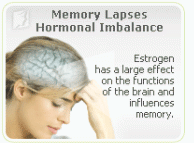
The discovery suggests that drugs can be developed to offset ?senior moments? related to low estrogen levels, as well as to protect against neurological diseases, all while avoiding the problems associated with adding estrogen to the body.
Writing online in Molecular Therapy in July, scientists with UF?s McKnight Brain Institute describe how they improved thought processes in female mice bred with the inability to produce estrogen receptor-alpha, a protein apparently necessary for healthy learning and memory.
?We were able to restore function in these animals, not by dosing them with estrogen, but by enabling them to use the estrogen that was naturally present in their bodies,? said Tom Foster, the Evelyn F. McKnight chair for brain research in memory loss at the UF College of Medicine. ?We discovered that you can affect the estrogen receptor directly in the hippocampus, right where it?s needed to address memory and spatial learning.?
Changes in the estrogen receptor have been associated with age-related memory deficits and an increased incidence of Alzheimer?s disease among women. In addition, previous studies have shown estrogen replacement may improve cognition in postmenopausal women and younger women with low estrogen levels. Estrogen also appears to protect against Alzheimer?s disease and dementia.
The downside is that estrogen is a powerful hormone that has far-reaching effects throughout the body. It has been associated with a slight increase in women?s risk for breast cancer, heart disease in patients with existing cardiovascular problems, and stroke.
?Estrogen may act as a growth agent for cancer, but in the brain, it appears to maintain health and counteract stress,? Foster said. ?We wanted to come back and enhance the signaling pathway that makes estrogen functional. We used a gene therapy technique that enables us to target the brain, but ultimately there could be a pharmaceutical that enhances the signaling pathway solely in the brain.?
Memory Lapses Treatment
Fortunately, most of the times memory lapses are not a condition that a woman must live with permanently; treatments are available. It is recommended to begin with the least invasive method and progress up to more drastic treatments if the symptom remains unaffected.
Lifestyle changes: that can be implemented into a woman?s life, such as dietary adjustments or a different exercise program. A balanced diet including additions such as omega-3 acids can help the ability to concentrate.
In addition, a wide variety of fresh fruit and vegetables are
important in order to obtain memory-boosting antioxidants and the vitamins B, C, D and E; all important for proper mental function. Mental exercises and games, such as crossword puzzles, Sudoku, or memory, have been shown to improve memory. Exercise and proper sleep also go a long
way.
Alternative Medicine: However, as the primary cause of memory lapses in menopausal women is the natural decline in estrogen that is typical of this age group, the most logical method of defeating this symptom is to address the fundamental hormonal imbalance. Natural supplements can be an easy, safe and effective treatment option.