Search Cidpusa web
How to identify a Trigger Point,
Common cause of neck pain
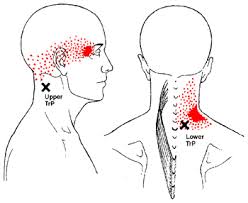
Do your neck and shoulders feel stiff when you awake in the morning? Or do they seize painfully with no warning? If so, you have plenty of company. Doctors estimate that seven out of 10 people will be troubled by neck pain at some point in their lives, often causing daily aching in the neck and shoulder area.
Neck pain is the cause of 90% of undiagnosed headaches. Rub olive oil, use a ice massage and a hot water bath to get rid of these pain. Most common cause is stress so please read the PTSD page.
Sometimes pain starts with the bang of a rear-end collision, but more often, the neck and its surrounding structures begin to ache after years of normal use, overuse, and misuse. Without knowing it, you may be encouraging neck and shoulder pain by the way you perform everyday activities. In general, try to keep your neck in a neutral position, which means your head balances directly over your shoulders and is not leaning forward or cocked to one side. Here are eight hints for achieving a healthy neck posture while performing everyday activities.
- At the computer or desk. When working at the computer or at a desk, keep your head balanced directly over your spine as much as possible. That means setting your chair height so both feet rest on the ground, and sitting with your buttocks far back in your chair, using a small pillow to support your lower back if needed. Properly adjusting the keyboard and monitor may be difficult or impossible with a laptop computer.
You can plug a separate, full-size keyboard into a laptop to help you achieve better positioning. But no matter how perfect your office-chair posture, it's important to get up, stretch, and move around every half hour. If you tend to get lost in your work, program your computer to flash a reminder. - Telephone use. If you spend a lot of time on the phone, try to avoid leaning your head to one side. This is also important when you use a cell phone and aren't sitting at your desk while you speak. A headset or speakerphone is a good option to help keep your head in a neutral position for hands-free talking. Headsets are available for both your desk phone and cell phone.
- Reading at home. If you are sitting in a chair, try to maintain an upright posture. Hold the book so that you don't have to lean down or forward to see it. A pillow on your lap may help. If you must read in bed, sit up straight or use a specially designed wedge pillow. Or lie on your side with your neck straight and hold the book in front of you.
- Walking. Avoid high heels, which change the alignment of your body from the ground up, characteristically ending in a head-thrust-forward position that stresses neck muscles. This may be one reason women have neck pain more than men do.
- Carrying a bag. Choose a lightweight purse or backpack, and don't overload. Don't sling a backpack over one shoulder. Try switching to a fanny pack or a backpack designed to put weight on the hips instead of just the upper back. With heavier loads, use a wheeled pack or briefcase. If you must hoist a purse on your shoulder, alternate which shoulder you use.
- Driving. Posture is a factor in whether a collision will cause whiplash. Your headrest should be high enough and close enough to catch your head in a rear-end collision. Position the seat so you can sit up straight with your head no more than two to four inches in front of the headrest. Adjust the headrest so its upper edge is level with the top of your head: the back curve of your skull should meet the cushion of the headrest.
- Lifting. Improper lifting techniques put stress on the neck as well as the lower back. Bend your hips and knees instead of your back. Keep the object close to you while straightening your legs. When lifting something over your head, don't tilt your neck backward. Strengthen your arms to make proper lifting easier.
- Watching TV. Sit far enough from a TV or movie screen that you can watch without tilting your head back. Don't sit off to the side, forcing you to turn your neck for long periods.
About 23 million persons, or 10 percent of the U.S. population, have one or more chronic disorders of the musculoskeletal system.
Trigger points are discrete, focal, hyperirritable spots located in a taut band of skeletal muscle. The spots are painful on compression and can produce referred pain, referred tenderness, motor dysfunction, and autonomic phenomena.
At home if you want to get rid of this pain rub ice over the painful point and then stretch that area. If its the knee move the leg up and down, if its the neck stretch from side to side.
See the electronic section for stimulation and getting rid of this problem forever you can purchase aTens unit for $15 .
Massaging with any oil like olive oil, walnut oil ,sesame seed oil will also get rid of this pain.
Turmeric powder mixed in a glass of water one eight of a tea spoon in a cup of milk will get rid of these pain if taken daily for a month.