|
|
|
Subcutaneous IVIg
Worlds TOP SITE ON IVIG (Read our
IVIg page) |
| |
Welcome
to the CIDP International organization
|
|
 |
If you need a Subcutaneous IVIg
, its safe, less side effects. IVIg
provider please contact .
If you are suffering from a
autoimmune disorder, read this for a possible cure of the
disease. Along with autoimmune disease prevention guidelines.
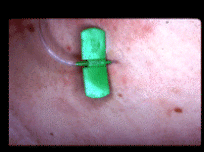
 a subcutaneous needle inserted
in tissue.
Pediatric Asthma, Allergy & Immunology
Aseptic Meningitis Due to Intravenous
Immunoglobulin Therapy That Resolved
with Subcutaneous Administration
Dec 2000, Vol. 14, No. 4: 323-327
Michael R. Nelson,
MD
Allergy-Immunology
Department, Walter Reed Army Medical
Center, Washington D.C.; Uniformed
Services University of the Health
Sciences, F. Edward Hebert School of
Medicine, Bethesda, Maryland.
Allergy-Immunology Department,
Walter Reed Army Medical Center,
Washington D.C.; Uniformed Services
University of the Health Sciences,
F. Edward Hebert School of Medicine,
Bethesda, Maryland.
Aseptic meningitis is a rare but well
recognized severe complication of
high-dose intravenous immunoglobulin
(IVIG) therapy. We report the case of a
9-year-old female who presented with
functional hypogammaglobulinemia and
recurrent sinopulmonary infections
refractory to antibiotic prophylaxis.
She was started on replacement dose IVIG
therapy that was complicated by the
development of headache, nuchal
rigidity, photophobia, fever, nausea,
vomiting, and lethargy after most
infusions. Clinical evaluation and two
cerebrospinal fluid analyses were
consistent with aseptic meningitis.
Interventions such as slower rates,
in-line filters, dilute preparations,
manufacturer change, and pretreatment
were largely ineffective. The addition
of post-IVIG oral corticosteroids
attenuated the severity of symptoms, but
the patient's quality-of-life and school
attendance continued to suffer. In light
of a continued need for therapy,
mounting intravenous access
difficulties, and requirement for
frequent high dose corticosteroids, a
trial of subcutaneous immunoglobulin
infusion was initiated. She has
tolerated this therapy for more than 3
years without serious adverse effects or
need for corticosteroids, and continues
to achieve clinical benefit by this
route. A recent rechallenge with IVIG
resulted in recurrent symptoms.
Disabling aseptic meningitis and severe
headache are rare complications of
replacement-dose IVIG. It is noteworthy
that aseptic meningitis has been
previously described for replacement
IVIG therapy in only one other child,
but the refractory nature of this side
effect in the index case described is
unique in the literature. Subcutaneous
immunoglobulin infusion is an effective
and well-tolerated alternative to IVIG,
especially in the setting of recurrent
aseptic meningitis. (Pediatr Asthma
Allergy Immunol 2000;14[4]:323  327.
|
|
|
Standard IVIG infusion

Subcutaneous Infusion leads to a improved IgG level.

Above slides from Melvin Berger MD Case Western
Reserve University |  |
| |
Subcutaneous immunoglobulin
replacement in patients with primary antibody deficiencies: safety and
costs.
Gardulf A,
Andersen V, Bjorkander J, Ericson D, Froland SS, Gustafson R, Hammarstrom L,
Jacobsen MB, Jonsson E, Moller G, et al.
Department of
Clinical Immunology, Karolinska Institute, Huddinge University Hospital,
Sweden.
Immunoglobulins (IgG) as replacement therapy in primary antibody
deficiencies can be given as intramuscular injections, or as intravenous or
subcutaneous infusions. Our aims were to obtain information on the frequency of
adverse systemic reactions during subcutaneous therapy, the occurrence and
intensity of tissue reactions at the infusion sites, and serum IgG changes.
Furthermore, we compared costs between the different replacement regimes. Our
study included 165 patients (69 women, 96 men, aged 13-76 years) with primary
hypogammaglobulinaemia or IgG-subclass deficiencies. Data were compiled from
questionnaires filled in by the patients and from their medical records. 33,168
subcutaneous infusions (27,030 in home therapy) had been given. 106 (of which 16
were at home) adverse systemic reactions (100 mild, 6 moderate) were recorded in
28 patients (17%). No severe or anaphylactoid reactions occurred. Despite large
immunoglobulin volumes given during 434 patient years (28,480 infusions), no
signs have been found that indicate the transmission of hepatitis virus.
Transient tissue reactions occurred at the infusion sites but were not
troublesome to most patients and we found significant increases in mean serum
IgG. The use of subcutaneous instead of intravenous infusions at home would
reduce the yearly cost per patient for the
health-care sector by US $10,100 in Sweden alone. We conclude that subcutaneous administration of IgG
is a safe and convenient method of providing immunoglobulins. We were able to
reach serum IgG concentrations similar to those by the intravenous therapy and
we found that the method could also be used successfully in patients with
previous severe or anaphylactoid reactions to intramuscular
injections.
------------------------------------------------------------------------
Immunoglobulin replacement treatment by rapid
subcutaneous infusion
J Gaspar, B Gerritsen,
A Jones
Department of Immunology, Great Ormond Street Hospital for
Children NHS Trust, London WC1N 3JH, UK
Correspondence to: J Gaspar or A Jones.
Accepted 7 January 1998
Long term intravenous immunoglobulin (IVIG) infusion is an
effective treatment for children with immunodeficiencies, but can
be complicated by poor venous access, systemic adverse
reactions, and the need for frequent hospital admission.
Rapid subcutaneous immunoglobulin (SCIG) infusion has
been found to be effective in adults with primary
immunodeficiency. Twenty six children were treated with
SCIG for a median period of two years (range six months
to 3.5 years). Fifteen children had previously been treated
with IVIG. Retrospective analysis showed that trough IgG
concentrations while receiving SCIG were comparable with
those while receiving IVIG during maintenance treatment.
In severe hypogammaglobulinaemia, however, initial
loading with SCIG or IVIG is probably indicated. During
the treatment period there was no systemic adverse reaction
nor severe reaction requiring admission to hospital. The
subjective impression of all families was a significant
improvement in the quality of life. This preliminary
experience with SCIG in children suggests that it is an
effective, convenient, and well tolerated alternative to
intravenous treatment. Larger prospective studies are
required to determine the place of SCIG in the management
of immunodeficiencies.
Keywords: immunoglobulin; subcutaneous infusion;
immunodeficiency
|
|
| |
|
|
| |
|
|
|