Neuropathy
~ July 2020 No.1 ~
Peripheral Neuropathy Fact Sheet
Prognosis The course of a neuropathy varies widely based on the etiology. With trauma or ischemia, the onset is acute, with maximum symptoms at onset. Inflammatory and some metabolic neuropathies have a subacute course extending over days to weeks. A more chronic course over weeks to months is the hallmark of most toxic and metabolic neuropathies. The very slowly progressive neuropathy over many years is the usual pattern of hereditary neuropathies or of chronic inflammatory demyelinating polyneuropathy.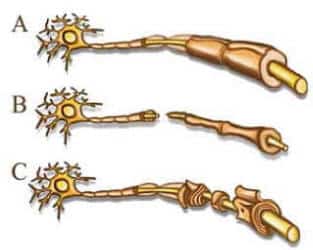
A) Normal B) Axonal neuropathy C) Demyelinating neuropathy
What is it?
Neuropathic means that your neural-system is damaged, and the condition comes in one or all of three forms, depending on which type of nerves have been damaged:
- Sensory Neuropathic Damage - This is when some parts of your body lose all sensation. For example the loss of feeling in the hands or feet. Some parts of the body become hypersensitive and you wake up in the night screaming as you receive random pain signals from every nerve in your body. Sensory neuropathy is by far the most common manifestation of alcoholic neurological dysfunction. This is manifested by poor peripheral sensation and occasionally neuropathic pain - which is more common in diabetics and people with multiple sclerosis than in alcoholic peripheral neuropathy.
- Autonomic Neuropathic Damage - This is when you can't feel whith your feet you need to look where to place your feet. Alcoholics do not tend to get autonomic neuropathies, certainly not as commonly as say diabetics. Loss of bladder function is one manifestation of autonomic neuropathies but this is usually not being able to pass urine rather than being incontinent. Others are a fall in blood pressure on standing and a fast heart rate. A condition alcoholics can get is Wernicke-Korsakoff disease due to vitamin B1 deficiency and heavy alcohol abuse which leads to ataxia (poor co-ordination and unsteady walking) and dementia.
- Motoric Neuropathic Damage - You're practically paralyzed and can't do anything at all. Your mouth has problems with speaking, people have difficulty understanding what you're saying and muscles think they receive signals from your brain and start to move uncontrollably. Motor neuropathies do not tend to involve the muscles of the face but often involve muscles of the extremities, with decreased power making walking difficult and also decrease in proprioception
proprioception="A term meaning being aware of the exact position of ones limbs." 2. Uncontrollable muscle movement is not characteristic of alcoholic neuropathy and occurs with primary brain lesions.
Not all sufferers of neuropathy have all three types of nerve damage. If only one type is damaged, the condition is called mononeuropathy; polyneuropathy usually means more than two nerve groups affected rather than a combination of sensory, autonomic and motor.
How Do You Get It?
B vitamins are essential, B1, B12, B6 and folate especially. However, in most cases the lack of vitamin B1 is not caused by eating too little. Vitamin B1 is broken down very quickly by alcohol, and drinking two bottles of wine or about eight bottles of beer a day for a few years willd o the trick. The onset of peripheral neuropathy is often insidious, although stopping drinking does usually help. Takeing vitamins especially D the B-1,B12, B6 should help quickly.
Continue to polyneuropathy page