God  our Guide  
cidpUSA Foundation

 cidpusa.org   


Natural makeup

Are You Hypothyroid

Deodorants 

 strokes

Learning

Learn Brain

Cure all disease

Cure for MS

Marfan


      Home
      Diagnosis
      Treatment
      Pathology
      Variants
      CIDP info
      Fibromyalgia
      IVIG
      Diet anti-inflammatory
      Burning  Feet Home
      Services Page
      Chronic Fatigue
      Autoimmune diseases
      Prognosis
      Bible healing
      Celiac disease
 
  Natural Makeup
  Neck Pain
  Ocular Female diseases
  Chronic fatigue syndrome
  Osteoporosis
  Women Heart Attacks
  Breast Size & Disease
  Female Sex Disease
  PARKINSON
  Memory problems
  Breast Lymph Drainage
  Kidney stone Buster
 Bras cause breast cancer
  Skin repair Clinic
 Pandas
  Hepatitis

Clinics of Excellence

 What is Chronic Fatigue

  Guide to Chronic fatigue

     Info on CFS

  Antibodies in CFS

 ALs Cidp

Learn about Self

Pork plant controversy

Backpain

Fibromyalgia

Personality

Electrical Stimulation Therapy

Addison

Estrogen

DNA

Magnets and ageing

Quranic Shifa

Vitamin D Deficency

Cupping

Pork plant controversy

Eliminate insulin implants

Sugar treatment

heart FAILURE

irregular periods

Myasthenia diet

 prophets

cancer survivor

Tomato as a medicine

Immune deficiency

Drug reaction prevention

   Prevent Osteoporosis

  Some rheumatic disorders

   Personality

  Alopecia treatment

   Alopecia general

  Nail Fungus

Deodorants cause Breast More young women getting strokes

Learning disability

Learn  about Brain

Cure all disease

Cure for MS

Bay leaves

Chemicals

Quranic Shifa


                                 Bechet  Page-1-Autoimmune diseases

                                    Get Expert Help Today  
            Cidpusa will do remote consultation at a low cost . Contact us no need to travel full internet based communication

For a complete simple guide to natural treatment of all diseases Flame within E-book.


Behcet's disease   Go to Page -2 of Bechet

What is Behcet's disease?

Behcet's  is a autoimmune disease is a rare disease characterized by painful mouth ulcers, genital ulcers, eye problems and skin lesions. The disease is named after the Turkish dermatologist Hulusi Behcet who first described the syndrome in 1924.


What causes Behcet's disease?

The cause of Behcet's disease is an autoimmune disorder. This is where an individual's immune system starts reacting against his or her own tissues. The reason it is possible bacterial or viral infection may have a role in its development.

Who is at risk of Behcet's disease?

Behcet's disease is most common and more serious in people with Silk Road bloodlines. Silk Road countries include those in the Mediterranean basin, Middle East and Far East; the incidence is around 1 in 10,000 people. However, Behcet's disease is seen worldwide even in those with other ethnic heritage; in the US the incidence is reported to be 1 in 20,000.

In people with Silk Road ancestry, Behcet's disease is more common in men than in women. However, the trend is reversed with more women than men being affected in people of other ethnic origins. The disease can develop at any age but is most common as people reach 20-30 years.


What are the signs and symptoms of Behcet's disease?

Mouth ulcers are the most common and earliest sign of Behcet's disease. However, before these appear a patient may for a number of years experience a variety of recurrent signs and symptoms that include:

  • Sore throats and tonsillitis
  • Muscular and joint pain
  • Malaise, generalised weakness
  • Anorexia, weight loss
  • Headache
  • Fluctuations in body temperature

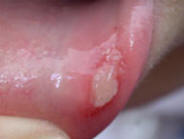
Painful mouth ulcers are usually the first outward sign of Behcet's disease and occur in about 70% of patients. Ulcers can occur anywhere in the mouth including on the tongue and inside the lips and cheeks. They usually last for 1-2 weeks but can remain for as long as 3 weeks.

Lip ulcer
Lip ulcer

Pathergy
Pathergy
Ulceration from blood test

Vulval ulcer
Vulval ulcer

Other common signs and symptoms indicative of Behcet's disease include:

  • Genital ulcers – these ulcers occur less often than mouth ulcers. They are painful and often heal with scarring. They are not genital herpes, which is caused by the herpes virus.
  • Eye involvement – uveitis, which is a reddening and swelling of the eye tissue, may occur. The retina may sometimes become involved and if not treated can lead to blindness.
  • Skin lesions – painful nodules from erythema nodosum are common. Patients may also have acne-like sores that occur on the arms, legs and trunk.

Less common symptoms include, gastrointestinal problems (e.g. abdominal pain, diarrhoea, vomiting), joint pain and swelling, nervous system problems and blood vessel and circulation problems.


How is Behcet's disease diagnosed?

Behcet's disease can be difficult to diagnose as signs and symptoms come and go and may not be apparent all at one time. If you have a history of recurrent mouth and genital ulcers, uveitis and skin sores this is suggestive of the condition.

The International criteria for classification of Behcet's disease defines the conditions as:

At least 3 episodes of recurrent oral ulcers in a 12-month period plus at least two more of the following:

  • Genital ulcers
  • Eye involvement (uveitis or retinal damage)
  • Skin lesions
  • Positive pathergy test (this is a skin prick test that can confirm Behcet's disease)

What is the treatment for Behcet's disease?

Currently there is no cure for Behcet's disease. The main goal is to treat and manage the symptoms so that complications do not develop. Because Behcet's disease affects so many different parts of the body, a team of doctors from various specialties will treat most people.

Some medications that may help in controlling symptoms include:

Topical therapy

  • Tetracycline solution
  • Topical corticosteroids
  • Local anaesthetics

Systemic therapy

  • Oral corticosteroids
  • Nonsteroidal anti-inflammatory drugs (e.g. aspirin, ibuprofen)
  • Immunosuppressants (e.g. azathioprine, chlorambucil)
  • Experimental and research drugs (e.g. cyclophosphamide, thalidomide)
  • Antibiotics are helpfull
  • Need help please contact us

What is the prognosis?

Behcet's disease is a chronic disease where the acute phases come and go with varying degrees of intensity. In the early stages of the disease attacks may be frequent and last for several weeks. As time progresses the intervals between attacks may become longer and in some cases attacks cease altogether. The disease is then considered to be in remission but may strike up again at any time.

Death occurs in about 4% of Behcet's cases. Causes of mortality are attributed to gastrointestinal perforation, central nervous system involvement and vascular aneurysms (ballooning of blood vessels).

Most Behcet's patients live out a full life although they will most likely deal with some level of symptoms throughout this time.

main diet page


     want to learn about the brain and spinal cord

 
     www.cidpusa.org/P/ivig.htm  http://www.cidpusa.org/disease.html http://www.cidpusa.org/Lahore.html