Search CIDPUSA WEBSITE
😏
Bechets Disease
Hippocrates may have been the first physician to describe this disease, several centuries B.C. In the 1930's, a Turkish dermatologist, Hulusi Behcet, noted the triad of aphthous oral ulcers, genital lesions, and recurrent eye inflammation, and became the first physician to describe the disease in modern times. Another name for Behcet's Disease is Behcet's syndrome.
Return to Neurological Variants of celiac diseaseReturn to Neurological Variants of celiac disease
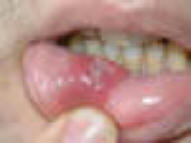 Ulcer in mouth
Behcet's disease is most common along the "Old Silk Route", which spans the region from Japan and China in the Far East to the Mediterranean Sea, including countries such as Turkey and Iran. Although the disease is rare in the United States, sporadic cases do occur in patients who would not appear to be at risk because of their ethnic backgrounds (e.g., in Caucasians or African-Americans). The disease is not rare in regions along the Old Silk Route, but the disease's epidemiology is not well understood. In Japan, Behcet's disease ranks as a leading cause of blindness. Below is a magnetic resonance image (MRI) study of a Behcet's patient demonstrating central nervous system involvement (white matter changes in the pons).
What causes it?
Behcet's disease, an autoimmune response where the immune system turns on the body, causes inflammation of parts of the body. In particular, small blood vessels around the body become inflamed, a condition known as vasculitis.
The cause of Behcet's remains unknown, but it's often preceded by a viral infection, for example, which may trigger the autoimmune process, causing the body to attack its own blood vessels and making them inflamed. Experts in the field of Behcet's research agree the causes may be genetic.
Life for people with Behcet's is made more difficult because of misunderstandings about the illness. With the appearance of ulcers on the mouth and genitals, it's often incorrectly assumed the condition is infectious and sexually transmitted - it's not either of these.
What are the symptoms?
Symptoms vary depending on which part of the body is affected by vasculitis.
Almost all of those with Behcet's suffer recurrent painful mouth ulcers that can make eating extremely difficult. Recurrent genital ulceration, inflammation of the eye (called uveitis) and skin lesions, such as an acne-like rash and red bumpy nodules (called erythema nodosum), occur.
If the joints are affected, then painful arthritis occurs and can cause severe disability. Sometimes the nerves and brain are affected, leading to impaired balance, speech and memory loss.
Symptoms come and go. Some people's symptoms flare up every few weeks or months, while others may go for years without problems.
Recurrent pain, fever and tiredness cause a great deal of fatigue. It's also easy for someone with a disease that lasts a lifetime and has no cure to also become depressed. Emotional support and understanding are essential and often provided through self-help groups.
Who's affected?
Although Behcet's can affect people of any age and has been diagnosed in young infants and people over the age of 70, it most commonly affects those between the ages of 20 and 40.
In western Europe and North America, more women are affected than men. However, in the 'silk route' countries of the Mediterranean Middle East and Far East, men are affected more often than women.
How is it diagnosed?
No specific test can diagnose Behcet's and its symptoms all have other possible causes. It needs a great deal of awareness to recognise the pattern of symptoms that, pieced together, may indicate Behcet's.
Tests are used to rule out other conditions that cause similar symptoms. A special skin-prick test can be performed that, if positive, adds more weight to Behcet's being the correct diagnosis.
What's the treatment?
There's no cure for Behcet's yet, but research continues and treatment is available to keep inflammation and symptoms at bay.
Treatment depends on which part of the body's affected and the severity of the symptoms. In general, topical steroids may be used for the ulcers and drops for eye inflammation. In more severe cases, oral steroids or immunosuppressant drugs may be used. Painkillers and anti-inflammatory medicines can relieve pain.
Get step by step instructions by email if you pay in services section
So to help women CIDPUSA has put together a guide for you to survive in this contaminated world.