Search Cidpusa web autoimmune disease easily and permanently treatable please read our e-book
Blood Clot Dangers
NHS rapped on blood clot deaths
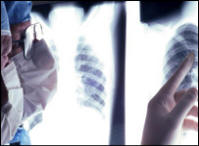
Clots can lodge in the lungs
 Thousands of hospital patients are dying unnecessarily of blood clots every year, says a report by MPs.
Clots kill more than 25,000 in England each year, yet many doctors are unaware and will not get clear prevention guidelines until May 2007, it claims.
As well as being too late, the guidance will not do enough to protect patients, the Commons health committee believes.
The Department of Health said it commissioned the guidelines because practice varied between hospitals.
Blood clots
The report looked at what was being done to prevent hospital patients in England getting dangerous blood clots called venous thromboembolisms (VTEs).
These include clots in the leg veins, called deep vein thromboses (DVTs), which can break off and lodge in the small vessels in the lung.
I find it shocking that this has been allowed to go unchecked for so longCommittee chairman David Hinchliffe
If this occurs the condition is called a pulmonary embolism, which is fatal in about a third of cases without treatment.
Pulmonary embolism following DVT kills more than breast cancer, Aids and traffic accidents combined, and 25 times more people than the superbug MRSA.
Many of these deaths are preventable with blood-thinning drugs and simple measures such as stretching exercises and compression stockings.
Yet hospital staff are not aware of the extent of the problem and there are no national guidelines to help them, says the House of Commons Health Committee.
'Don't delay'
The Government asked the National Institute for Clinical Excellence (NICE) to look at the problem and report back in 2007.
Health Committee chairman David Hinchliffe said: "I find it shocking that this has been allowed to go unchecked for so long.
"The guidelines which the NHS plan to introduce in May 2007 are too late, too narrow in scope and will not go far enough to prevent more unnecessary deaths."
The committee says all hospital patients should be assessed and given preventive treatment against clots, rather than just those about to undergo surgery who are known to be particularly high risk, as will be recommended in the 2007 guidelines.
VTE RISK FACTORS
Immobility
Surgery
Obesity
Pregnancy and the oral contraceptive pill
Blood disorders that affect clotting
Long distance air travel
Each hospital should also create a 'thrombosis team' as soon as possible, which would be charged with the responsibility of educating staff and making sure guidelines are followed, it advises.
Another problem, says the committee, is that many patients who develop clots show signs that something is wrong only after they have been discharged from hospitals.
This means the doctor who treated the patient in hospital is often not informed that their patient had a VTE.
Dr David Keeling, who gave advice to the committee on behalf of the Royal College of Physicians, said many medics concentrated on treating surgical patients and forgot about medical patients, who are "also at risk".
Conservative Shadow Health Secretary Andrew Lansley said: "This report highlights where further progress can, and must be made, in improving NHS services.
"The next Conservative government will ensure the NHS has the resources, freedoms and standards to enable that to happen."
A Department of Health spokeswoman said they asked NICE to look draw up guidelines because practice varies widely between hospitals.
She said data showed about four out of 10 orthopaedic patients did not receive any form of preventative treatment against blood clots.
But she said: "No one is waiting around until 2007.
"There is currently a variety of treatment options available for people with VTE. Patients should discuss these with their clinicians."
continue to page-2 to learn how to become a superhuman
July-1 -2021