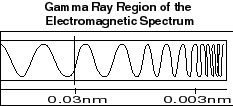
Gamma-rays have the smallest wavelengths
and the most energy of any other wave in the
electromagnetic spectrum. These waves are
generated by radioactive atoms and in
nuclear explosions. Gamma-rays can kill
living cells, a fact which medicine uses to
its advantage, using gamma-rays to kill
cancerous cells.
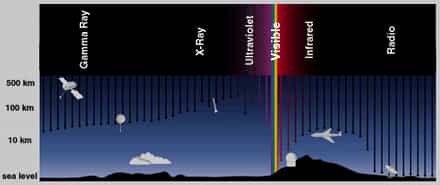
Gamma-rays travel to us across vast
distances of the universe, only to be
absorbed by the Earth's atmosphere.
Different wavelengths of light penetrate the
Earth's atmosphere to different depths.
Instruments aboard high-altitude balloons
and satellites like the Compton Observatory
provide our only view of the gamma-ray sky.

Gamma-rays are the most energetic form of
light and are produced by the hottest
regions of the universe. They are also
produced by such violent events as supernova
explosions or the destruction of atoms, and
by less dramatic events, such as the decay
of radioactive material in space. Things
like supernova explosions (the way massive
stars die), neutron stars and pulsars, and
black holes are all sources of celestial
gamma-rays.
How do we "see" using gamma-ray light?
Gamma-ray astronomy did not develop until
it was possible to get our detectors above
all or most of the atmosphere, using
balloons or spacecraft. The first gamma-ray
telescope, carried into orbit on the
Explorer XI satellite in 1961, picked up
fewer than 100 cosmic gamma-ray photons!
Unlike optical light and X-rays, gamma
rays cannot be captured and reflected in
mirrors. The high-energy photons would pass
right through such a device. Gamma-ray
telescopes use a process called Compton
scattering, where a gamma-ray strikes an
electron and loses energy, similar to a cue
ball striking an eight ball.
|
This image shows the
CGRO satellite being deployed from
the Space Shuttle orbiter. This
picture was taken from an orbiter
window. The two round protrusions
are one of CGRO's instruments,
called "EGRET".
|
What do gamma-rays show us?
| If you could see
gamma-rays, the night sky would look
strange and unfamiliar.
The gamma-ray moon just looks
like a round blob - lunar features
are not visible. In high-energy
gamma rays, the Moon is actually
brighter than the quiet Sun. This
image was taken by EGRET. |
Credit: D.J. Thompson, D.L. Bertsch (NASA/GSFC),
D.J. Morris (UNH), R. Mukherjee
(NASA/GSFC/USRA)
|
The familiar sights of constantly shining
stars and galaxies would be replaced by
something ever-changing. Your gamma-ray
vision would peer into the hearts of solar
flares, supernovae, neutron stars, black
holes, and active galaxies. Gamma-ray
astronomy presents unique opportunities to
explore these exotic objects. By exploring
the universe at these high energies,
scientists can search for new physics,
testing theories and performing experiments
which are not possible in earth-bound
laboratories.

  |
If
you could see gamma-rays, these two
spinning neutron stars or pulsars
would be among the brightest objects
in the sky. This computer processed
image shows the Crab Nebula pulsar
(below and right of center) and the
Geminga pulsar (above and left of
center) in the "light" of
gamma-rays.
|
The Crab nebula, shown also in the
visible light image, was created by a
supernova that brightened the night sky in
1054 A.D. In 1967, astronomers detected the
remnant core of that star; a rapidly
rotating, magnetic pulsar flashing every
0.33 second in radio waves.
Perhaps the most spectacular discovery in
gamma-ray astronomy came in the late 1960s
and early 1970s. Detectors on board the Vela
satellite series, originally military
satellites, began to record bursts of
gamma-rays -- not from Earth, but from deep
space!

|
Today, these
gamma-ray bursts, which happen at
least once a day, are seen to last
for fractions of a second to
minutes, popping off like cosmic
flashbulbs from unexpected
directions, flickering, and then
fading after briefly dominating the
gamma-ray sky. |
Gamma-ray bursts can
release more energy in 10 seconds than the
Sun will emit in its entire 10 billion-year
lifetime! So far, it appears that all of the
bursts we have observed have come from
outside the Milky Way Galaxy. Scientists
believe that a gamma-ray burst will occur
once every few million years here in the
Milky Way, and in fact may occur once every
several hundred million years within a few
thousand light-years of Earth.
Studied for over 25 years now with
instruments on board a variety of satellites
and space probes, including Soviet Venera
spacecraft and the Pioneer Venus Orbiter,
the sources of these enigmatic high-energy
flashes remain a mystery.
By solving the mystery of gamma-ray
bursts, scientists hope to gain further
knowledge of the origins of the Universe,
the rate at which the Universe is expanding,
and the size of the Universe.