Ultraviolet Waves
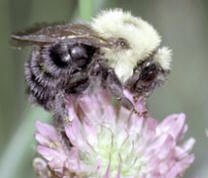
| Ultraviolet (UV)
light has shorter wavelengths than visible
light. Though these waves are invisible to the
human eye, some insects, like bumblebees, can
see them! (Image of the bumblebee is courtesty
of Mark Cassino.) |
 |
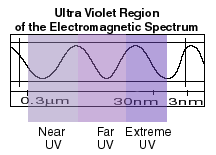
Scientists have divided the
ultraviolet part of the spectrum into three regions: the
near ultraviolet, the far ultraviolet, and the extreme
ultraviolet. The three regions are distinguished by how
energetic the ultraviolet radiation is, and by the
"wavelength" of the ultraviolet light, which is related
to energy.
The near ultraviolet, abbreviated NUV, is the light
closest to optical or visible light. The extreme
ultraviolet, abbreviated EUV, is the ultraviolet light
closest to X-rays, and is the most energetic of the
three types. The far ultraviolet, abbreviated FUV, lies
between the near and extreme ultraviolet regions. It is
the least explored of the three regions.
|
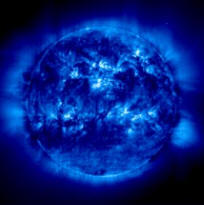
Our Sun emits
light at all the different wavelengths in
electromagnetic spectrum, but it is ultraviolet
waves that are responsible for causing our
sunburns. To the left is an image of the Sun
taken at an Extreme Ultraviolet wavelength - 171
Angstroms to be exact. (An Angstrom is a unit
length equal to 10-10 meters.) This
image was taken by a satellite named SOHO and it
shows what the Sun looked like on April 24,
2000. |
Though some ultraviolet waves from the Sun penetrate
Earth's atmosphere, most of them are blocked from
entering by various gases like Ozone. Some days, more
ultraviolet waves get through our atmosphere. Scientists
have developed a UV index to help people protect
themselves from these harmful ultraviolet waves.
How do we "see" using Ultraviolet light?
It is good for humans that we are protected from
getting too much ultraviolet radiation, but it is bad
for scientists! Astronomers have to put ultraviolet
telescopes on satellites to measure the ultraviolet
light from stars and galaxies - and even closer things
like the Sun!
| There are many
different satellites that help us study
ultraviolet astronomy. Many of them only detect
a small portion of UV light. For example, the
Hubble Space Telescope observes stars and
galaxies mostly in near ultraviolet light.
NASA's Extreme Ultraviolet Explorer satellite is
currently exploring the extreme ultraviolet
universe. The International Ultraviolet Explorer
(IUE) satellite has observed in the far and near
ultraviolet regions for over 17 years.
|
 |
What does Ultraviolet light show us?
We can study stars and galaxies by studying the UV
light they give off - but did you know we can even study
the Earth? Below is an unusual image - it is a picture
of Earth taken from a lunar observatory! This
false-color picture shows how the Earth glows in
ultraviolet (UV) light.
| The Far UV
Camera/Spectrograph deployed and left on the
Moon by the crew of Apollo 16 took this picture.
The part of the Earth facing the Sun reflects
much UV light. Even more interesting is the side
facing away from the Sun. Here, bands of UV
emission are also apparent. These bands are the
result of aurora caused by charged particles
given off by the Sun. They spiral towards the
Earth along Earth's magnetic field lines.
|
 |
Many scientists are interested in studying the
invisible universe of ultraviolet light, since the
hottest and the most active objects in the cosmos give
off large amounts of ultraviolet energy.
The image below shows three different galaxies taken
in visible light (bottom three images) and ultraviolet
light (top row) taken by NASA's Ultraviolet Imaging
Telescope (UIT) on the Astro-2 mission.

The difference in how the galaxies appear is due to
which type of stars shine brightest in the optical and
ultraviolet wavelengths. Pictures of galaxies like the
ones below show mainly clouds of gas containing newly
formed stars many times more massive than the sun, which
glow strongly in ultraviolet light. In contrast, visible
light pictures of galaxies show mostly the yellow and
red light of older stars. By comparing these types of
data, astronomers can learn about the structure and
evolution of galaxies.
|