Radio Waves
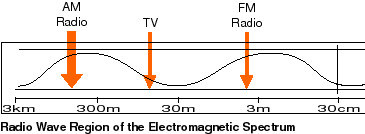
| Radio waves have the
longest wavelengths in the
electromagnetic spectrum. These
waves can be longer than a football
field or as short as a football.
Radio waves do more than just bring
music to your radio. They also carry
signals for your television and
cellular phones. |
 |
|
The antennae on your
television set receive the signal,
in the form of electromagnetic
waves, that is broadcasted from the
television station. It is displayed
on your television screen.
Cable companies have antennae or
dishes which receive waves
broadcasted from your local TV
stations. The signal is then sent
through a cable to your house.
Why are car antennae
about the same size as TV antennae? |
|
Cellular phones also
use radio waves to transmit
information. These waves are much
smaller that TV and FM radio waves.
Why are antennae on cell
phones smaller than antennae on your
radio? |
|
How do we "see" using Radio Waves?
Objects in space, such as
planets and comets, giant clouds of gas and
dust, and stars and galaxies, emit light at
many different wavelengths. Some of the
light they emit has very large wavelengths -
sometimes as long as a mile!. These long
waves are in the radio region of the
electromagnetic spectrum.
|
Because radio waves are larger than
optical waves, radio telescopes work
differently than telescopes that we
use for visible > light (optical
telescopes). Radio telescopes are
dishes made out of conducting metal
that reflect radio waves to a focus
point. Because the wavelengths of
radio light are so large, a radio
telescope must be physically larger
than an optical telescope to be able
to make images of comparable
clarity. For example, the Parkes
radio telescope, which has a dish 64
meters wide, cannot give us any
clearer an image than a small
backyard telescope!
In order to make better and more
clear (or higher resolution) radio
images, radio astronomers often
combine several smaller telescopes,
or receiving dishes, into an array.
Together, the dishes can act as one
large telescope whose size equals
the total area occupied by the
array.
|
 |
|
The Very Large Array (VLA) is one of
the world's premier astronomical
radio observatories. The VLA
consists of 27 antennas arranged in
a huge "Y" pattern up to 36 km (22
miles) across -- roughly one and a
half times the size of Washington,
DC. |
|
The VLA, located in New Mexico, is an
interferometer; this means that it operates
by multiplying the data from each pair of
telescopes together to form interference
patterns. The structure of those
interference patterns, and how they change
with time as the earth rotates, reflect the
structure of radio sources in the sky.
What do Radio Waves show us?
The above image shows the Carbon Monoxide
(CO) gases in our Milky Way galaxy.
Many astronomical objects emit radio
waves, but that fact wasn't discovered until
1932. Since then, astronomers have developed
sophisticated systems that allow them to
make pictures from the radio waves emitted
by astronomical objects.
|
Radio telescopes look toward the
heavens at planets and comets, giant
clouds of gas and dust, and stars
and galaxies. By studying the radio
waves originating from these
sources, astronomers can learn about
their composition, structure, and
motion. Radio astronomy has the
advantage that sunlight, clouds, and
rain do not affect observations.
|
| Did
you know that radio
astronomy observatories use
diesel cars around the
telescopes? The ignition of
the spark plugs in
gasoline-powered cars can
interfere with radio
observations - just like
running a vacuum can
interfere with your
television reception!
|
|
|