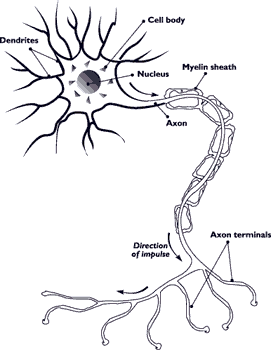
| A nerve cell is called a neuron and it transmits its messages by the axon.
The nucleus of a neuron is located in the cell body. Extending out from the
cell body are processes called dendrites and axons. These processes serve to conduct impulses (with dendrites
conducting impulses toward the cell body and axons conducting impulses away from
the cell body).
Source:
http://www.drugabuse.gov/MOM/TG/momtg-introbg.html
Neurons can respond to stimuli and conduct impulses because a membrane
potential is established across the cell membrane. In other words, there is an
unequal distribution of ions (charged atoms) on the two sides of a nerve cell
membrane. This is illustrated with a voltmeter:
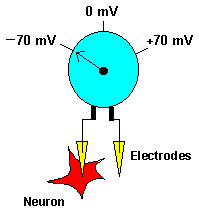
With one electrode placed inside a neuron and another outside, the
voltmeter is 'measuring' the difference in the distribution of ions on the
inside versus the outside. And, in this example, the voltmeter reads -70 mV (mV
= millivolts). In other words, the inside of the neuron is slightly negative
relative to the outside. This difference is referred to as the Resting Membrane
Potential. How is this potential established?
Establishment of the Resting Membrane Potential
Membranes are polarized or, in other words, exhibit a
RESTING MEMBRANE POTENTIAL. This means that there is an unequal distribution
of ions (atoms with a positive or negative charge) on the two sides of the nerve
cell membrane. This POTENTIAL generally measures about 70 millivolts (with the
INSIDE of the membrane negative with respect to the outside). So, the RESTING
MEMBRANE POTENTIAL is expressed as -70 mV, and the minus means that the inside
is negative relative to (or compared to) the outside. It is called a RESTING
potential because it occurs when a membrane is not being stimulated or
conducting impulses (in other words, it's resting).
Source:
http://www.millersv.edu/~bio375/CELL/membrane/membrane.htm
What factors contribute to this membrane potential?
Two ions are responsible: sodium (Na+) and potassium
(K+). An unequal distribution of these two ions occurs on
the two sides of a nerve cell membrane because carriers actively transport these
two ions: sodium from the inside to the outside and potassium from the outside
to the inside. AS A RESULT of this active transport mechanism (commonly referred
to as the
SODIUM - POTASSIUM PUMP), there is a higher concentration of sodium on the
outside than the inside and a higher concentration of potassium on the inside
than the outside.
Source:
http://ifcsun1.ifisiol.unam.mx/Brain/mempot.htm
The nerve cell membrane also contains special passageways for these two ions
that are commonly referred to as GATES or CHANNELS.
Thus, there are SODIUM GATES and POTASSIUM GATES. These gates represent the only
way that these ions can pass through the nerve cell membrane. IN A RESTING NERVE
CELL MEMBRANE, all the sodium gates are closed and some of the potassium gates
are open. AS A RESULT, sodium cannot diffuse through the membrane & largely
remains outside the membrane. HOWEVER, some potassium ions are able to diffuse
out.
OVERALL, THEREFORE, there are lots of positively charged potassium ions just
inside the membrane and lots of positively charged sodium ions PLUS some
potassium ions on the outside. THIS MEANS THAT THERE ARE MORE POSITIVE CHARGES
ON THE OUTSIDE THAN ON THE INSIDE. In other words, there is an unequal
distribution of ions or a resting membrane potential. This potential will be
maintained until the membrane is disturbed or stimulated. Then, if it's a
sufficiently strong stimulus, an action potential will occur.
ACTION POTENTIAL
An action potential is a very rapid change in membrane potential that occurs
when a nerve cell membrane is stimulated. Specifically, the membrane potential
goes from the resting potential (typically -70 mV) to some positive value
(typically about +30 mV) in a very short period of time (just a few
milliseconds).
Source:
http://faculty.washington.edu/chudler/ap.html
What causes this change in potential to occur? The
stimulus
causes the sodium gates (or channels) to open and, because there's more
sodium on the outside than the inside of the membrane, sodium then diffuses
rapidly into the nerve cell. All these positively-charged sodiums rushing in
causes the membrane potential to become positive (the inside of the membrane is
now positive relative to the outside). The sodium channels open only briefly,
then close again.
Source:http://www.vet.purdue.edu/depts/bms/courses/bms511/coursework/nervous/n3.htm
The
potassium channels then open, and, because there is more potassium inside
the membrane than outside, positively-charged potassium ions diffuse out. As
these positive ions go out, the inside of the membrane once again becomes
negative with respect to the outside.
Source:
http://faculty.washington.edu/chudler/ap.html
Threshold stimulus & potential
- Action potentials occur only when the membrane in stimulated
(depolarized) enough so that sodium channels open completely. The minimum
stimulus needed to achieve an action potential is called the threshold
stimulus.

- The threshold stimulus causes the membrane potential to become less
negative (because a stimulus, no matter how small, causes a few sodium
channels to open and allows some positively-charged sodium ions to diffuse
in).
- If the membrane potential reaches the threshold potential
(generally 5 - 15 mV less negative than the resting potential), the
voltage-regulated sodium channels all open. Sodium ions rapidly diffuse
inward, & depolarization occurs.
All-or-None Law - action potentials occur maximally or not at all. In
other words, there's no such thing as a partial or weak action potential. Either
the threshold potential is reached and an action potential occurs, or it isn't
reached and no action potential occurs.
Refractory periods:
ABSOLUTE -
- During an action potential, a second stimulus will not produce a
second action potential (no matter how strong that stimulus is)
- corresponds to the period when the sodium channels are open
(typically just a millisecond or less)
Source:
http://members.aol.com/Bio50/LecNotes/lecnot11.html

RELATIVE -
- Another action potential can be produced, but only if the stimulus
is greater than the threshold stimulus
- corresponds to the period when the potassium channels are open
(several milliseconds)
- the nerve cell membrane becomes progressively more 'sensitive'
(easier to stimulate) as the relative refractory period proceeds. So, it
takes a very strong stimulus to cause an action potential at the
beginning of the relative refractory period, but only a slightly above
threshold stimulus to cause an action potential near the end of the
relative refractory period.
Impulse
conduction - an impulse is simply the movement of action potentials
along a nerve cell. Action potentials are localized (only affect a small area of
nerve cell membrane). So, when one occurs, only a small area of membrane
depolarizes (or 'reverses' potential). As a result, for a split second, areas of
membrane adjacent to each other have opposite charges (the depolarized membrane
is negative on the outside & positive on the inside, while the adjacent areas
are still positive on the outside and negative on the inside). An electrical
circuit (or 'mini-circuit') develops between these oppositely-charged areas (or,
in other words, electrons flow between these areas). This 'mini-circuit'
stimulates the adjacent area and, therefore, an action potential occurs. This
process repeats itself and action potentials move down the nerve cell membrane.
This 'movement' of action potentials is called an impulse.

Conduction Velocity:
- Impulses typically travel along neurons at a speed of anywhere from 1 to
120 meters per second
- The speed of conduction can be influenced by:
- The diameter of a fiber (Greater the
diameter faster the conduction).
- Temperature ( Colder the temperature slower
the conduction) .
- The presence or absence of myelin ( Myelin
acts as a Turbocharger)
Neurons with myelin (or myelinated neurons) conduct impulses much faster than
those without myelin.
Schwann cells are located at regular intervals along the process (axons and,
for some neurons, dendrites) & so a section of a myelinated axon would look like
this:
Between areas of myelin are non-myelinated areas called the nodes of Ranvier.
Because fat (myelin) acts as an insulator, membrane coated with myelin will not
conduct an impulse. So, in a myelinated neuron, action potentials only occur
along the nodes and, therefore, impulses 'jump' over the areas of myelin - going
from node to node in a process called saltatory conduction (with the word
saltatory meaning 'jumping'):
Because the impulse 'jumps' over areas of myelin, an impulse travels much
faster along a myelinated neuron than along a non-myelinated neuron.
Types of Neurons - the three main types of neurons are:
Multipolar
neuron |
Unipolar
neuron |
Bipolar neuron |
Multipolar neurons are so-named because they have many (multi-)
processes that extend from the cell body: lots of dendrites plus a single axon.
Functionally, these neurons are either motor (conducting impulses that will
cause activity such as the contraction of muscles) or association (conducting
impulses and permitting 'communication' between neurons within the central
nervous system).
Unipolar neurons have but one process from the cell body. However,
that single, very short, process splits into longer processes (a dendrite plus
an axon). Unipolar neurons are sensory neurons - conducting impulses into the
central nervous system.
Bipolar neurons have two processes - one axon & one dendrite. These
neurons are also sensory. For example, biopolar neurons can be found in the
retina of the eye.
Neuroglial, or
glial, cells - general functions include:
1 - forming myelin sheaths
2 - protecting neurons (via phagocytosis)
3 - regulating the internal environment of neurons
in the central nervous system
Synapse
= point of impulse transmission between neurons; impulses are transmitted
from pre-synaptic neurons to post-synaptic neurons
Synapses usually occur between the axon of a pre-synaptic neuron & a dendrite
or cell body of a post-synaptic neuron. At a synapse, the end of the axon is
'swollen' and referred to as an end bulb or synaptic knob. Within the end bulb
are found lots of synaptic vesicles (which contain
neurotransmitter
chemicals) and mitochondria (which provide ATP to make more
neurotransmitter). Between the end bulb and the dendrite (or cell body) of the
post-synaptic neuron, there is a gap commonly referred to as the synaptic cleft.
So, pre- and post-synaptic membranes do not actually come in contact. That means
that the impulse cannot be transmitted directly. Rather, the impulse is
transmitted by the release of chemicals called chemical transmitters (or
neurotransmitters).

When an impulse arrives at the end bulb, the end bulb membrane becomes
more permeable to calcium. Calcium diffuses into the end bulb & activates
enzymes that cause the synaptic vesicles to move toward the synaptic cleft. Some
vesicles fuse with the membrane and release their neurotransmitter (a good
example of exocytosis). The neurotransmitter molecules diffuse across the cleft
and fit into receptor sites in the postsynaptic membrane. When these sites are
filled, sodium
channels (also called, as in the figure above, chemically gated ion channels)
open & permit an inward diffusion of sodium ions. This, of course, causes
the membrane potential to become less negative (or, in other words, to approach
the threshold potential). If enough neurotransmitter is released, and enough
sodium channels are opened, then the membrane potential will reach threshold. If
so, an action potential occurs and spreads along the membrane of the
post-synaptic neuron (in other words, the impulse will be transmitted). Of
course, if insufficient neurotransmitter is released, the impulse will not be
transmitted.
Source:
http://www.franklincoll.edu/bioweb/bio120/week2.htm
This describes what happens when an 'excitatory' neurotransmitter is released
at a synapse. However, not all neurotransmitters are 'excitatory':
Types of neurotransmitters:
1- Excitatory - neurotransmitters that make membrane potential less negative
(via increased permeability of the membrane to sodium) &, therefore, tend to
'excite' or stimulate the postsynaptic membrane
2 - Inhibitory - neurotransmitters that make membrane potential more
negative (via increased permeability of the membrane to potassium) &,
therefore, tend to 'inhibit' (or make less likely) the transmission of an
impulse. One example of an inhibitory neurotransmitter is gamma aminobutyric
acid (GABA; shown below). Medically, GABA has been used to treat both
epilepsy and hypertension. Another example of an inhibitory neurotransmitter
is beta-endorphin, which results in decreased pain perception by the CNS.
Used by permission of
John W. Kimball
Summation:
1 - Temporal summation - transmission of an impulse by rapid stimulation of
one or more pre-synaptic neurons
2 - Spatial summation - transmission of an impulse by simultaneous or
nearly simultaneous stimulation of two or more pre-synaptic neurons
Used by permission of
John W. Kimball
www.cidpusa.org
www.cidpusa.org/P/ivig.htm
http://www.cidpusa.org/disease.html
http://www.cidpusa.org/Lahore.html
|