James M. Daniels, MD, MPH; Tim Ishmael, MD; Robert M. Wesley, MA
In Brief: Musculoskeletal complaints are among the leading
reasons for visits to physicians, and about one third of these
patients meet diagnostic criteria for myofascial pain syndrome
(MPS). Although MPS was identified more than a century ago, debate
over its existence as a separate clinical entity continues.
Physicians who learn to identify characteristic symptoms can
differentiate MPS from fibromyalgia and provide effective treatment.
Key to treatment is identification of trigger points that when
stimulated produce patterns of pain throughout a limb or region.
Treatment modalities for MPS include trigger point injection,
shiatsu, and the spray and stretch technique. Prognosis for MPS is
better than that for fibromyalgia, and treatment usually follows an
individualized regimen.
The musculoskeletal
system comprises more than 400 individual muscles and is the largest
organ system by weight in the human body.1
A recent study2
identified musculoskeletal complaints as one of the leading causes
for patients to visit a primary care provider. As many as one third
of these patients had symptoms that met the diagnostic criteria for
myofascial pain syndrome (MPS).1
Although MPS has been described variously in the literature since
1843,3
the debate over its existence continues. Whether one takes the
position that it is a subset of fibromyalgia or a separate entity,
treatment for MPS differs from that of fibromyalgia, as does its
prognosis. Patients who have MPS often have regional pain symptoms
after a relatively minor trauma or muscle overuse.
Describing and Distinguishing the Pathology
Simons et al1
have defined regional MPS as a condition in which the patient has
"hyperirritable spots" or "trigger points" within taut bands of
skeletal muscle or fascia that are painful on compression and can
give rise to characteristic referred pain, tenderness, and autonomic
nervous system symptoms. Pain from MPS can be described as deep and
achy, and it is occasionally accompanied by a sensation of burning
or stinging. Patients may also report restricted range of motion in
the area affected. MPS is limited to one area or quadrant of the
body.1
Differentiating the disorders. In 1990, the American
College of Rheumatology developed criteria for the diagnosis of
fibromyalgia,4
a condition that can sometimes be confused with MPS. MPS can be
distinguished from fibromyalgia in a number of ways (table 1).
Fibromyalgia is a disorder of sleep that affects areas throughout
the body,4
while MPS is a disorder of muscle physiology, affecting only one
region or extremity. In addition, MPS has a much better prognosis
than fibromyalgia.5,6
|
| Feature |
Trigger Points of
Myofascial Pain Syndrome |
Tender Points of
Fibromyalgia |
|
| Tender
points |
Localized |
Multiple, generalized |
|
Musculoskeletal pain |
Localized |
Generalized |
| Taut
band |
No
variation from normal |
No
variation from normal |
| Twitch
response |
No
variation from normal |
Probably normal |
|
Referred pain |
More
frequent |
Less
frequent |
|
Fatigue |
Less
frequent |
More
frequent |
| Poor
sleep |
Less
frequent |
More
frequent |
|
Paresthesia |
Less
frequent |
More
frequent |
|
Headaches |
Less
frequent |
More
frequent |
|
Irritable bowel |
Less
frequent |
More
frequent |
|
Sensation of swelling |
Less
frequent |
More
frequent |
|
|
|
|
Some clinicians are skeptical that MPS is a distinct disorder and
believe that the condition is a subset of fibromyalgia.7
The early literature on these conditions uses the two diagnoses
interchangeably. Much of the controversy centers around
differentiating the "tender points" found in patients with
fibromyalgia and the "trigger points" found in patients with MPS.
The trigger point may be associated with a local "jump response" or
"jump sign." Thus, when physicians palpate the affected muscle, they
feel a "knotted" or "doughy" area, and the patient may instinctively
recoil or jump when the area is identified. A tender point
associated with fibromyalgia may not be detected when palpated and
may represent only an area of maximum tenderness within a sore
muscle. Tender points are not associated with referred pain
patterns, jump signs, or the motor endplates of the muscle-nerve
interface.
One study7
employed clinical experts to perform tender point examinations on
three groups of patients. A small number of patients were
prediagnosed with either fibromyalgia or MPS. These patients were
compared with 80 "healthy" patients. The experts found taut bands of
muscle and muscle twitches in both healthy controls and in patients
with either of the conditions. A liberal definition of "trigger
points" by these investigators produced overlap between the
fibromyalgia group and the MPS group, and local areas of tenderness
or "tender spots" were found in both groups.7
A second study8
of similar design found that dolorimetry and palpation were very
reliable in discriminating between control patients and those with
MPS or fibromyalgia.
Muscle Basics, Trigger Points, and Pain Patterns
A review of structural and physiologic principles of muscle
contraction helps address syndrome etiology and provides tips on
trigger point identification.
Muscle structure and contraction. Skeletal muscle is an
assembly of fascicles, each of which is a bundle of roughly 100
muscle fibers. Each muscle fiber or cell encloses approximately
1,000 to 2,000 myofibrils. Myofibrils consist of chains of
sarcomeres connected serially, end-to-end. Individual sarcomeres are
basic contractile units of skeletal muscle connected by z-lines,
often described as "links in a chain" when visualized under the
microscope. Each sarcomere is composed of actin and myosin molecules
that form cross-bridges in the presence of ionized calcium.
When adenosine triphosphate (ATP) is bound to myosin, the
actin-myosin cross-bridge remains relaxed (not attached). Hydrolysis
of ATP into adenosine diphosphate (ADP) results in the interaction
or crossbridging of the actin and myosin proteins. ADP then
dissociates from the myosin, causing it to bend or "cock," thus
pulling on the actin and shortening the sarcomere. Reattachment of
another ATP releases the cross-bridge and uncocks the myosin,
allowing the process to start over. As these cycles are repeated,
the muscle contracts. When calcium is removed, the contraction is
terminated. Without additional ATP input, the cross-bridges remain
attached, myosin staythin the
muscles affects the pain pathway.
In MPS, palpating the muscle is painful. The pain is relieved by
Such stretching is exquisitely painful and requires temporarily
blocking pain receptors while the involved muscle is stretched. This
phenomenon is the reason that spray and stretch, local injection,
and acupressure—all of which inhibit pain and motor reflex—are
employed in treatment as the muscle is stretched to length.
Although many theories responsible for MPS have been postulated,5,11
no clear causal factors have been identified. Clinical studies have
shown some association between MPS and prolonged static postures,
lack of exercise, sleep disturbance, and emotional stress.5
With minimal training, clinicians can identify this syndrome based
solely on history and physical examination findings.
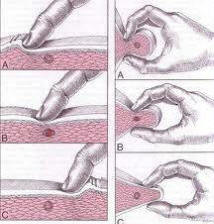
Identifying trigger points. The recommended criteria for
identifying trigger points consist of essential criteria and
confirmatory observations (table 2).1
Using pain diagrams, examiners can compare patient trigger points
identified with those known from published drawings (figure 1).5,10,12,13
Please go to next page