CIDPUSA.ORG ❤
Autoimmune Diseases Web
Wilsonm Diases
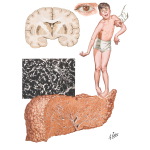 Lenticular
Wilson’s disease (WD) is a rare inherited disorder in which excessive amounts of copper accumulate in the body. The buildup of copper leads to damage in the kidneys, brain, and eyes.
Although copper accumulation begins at birth, symptoms of the disorder appear later in life. The most characteristic symptom of WD is the Kayser-Fleisher ring – a rusty brown ring around
the cornea of the eye that can best be viewed using an ophthalmologist’s slit lamp. The primary consequence for most of those with WD is liver disease, appearing in late childhood or
early adolescence as acute hepatitis, liver failure, or progressive chronic liver disease in the form of chronic active hepatitis or cirrhosis of the liver. In others, the first
symptoms occur later in adulthood and most commonly include slurred speech (dysarthria), difficulty swallowing (dysphagia), and drooling. Other symptoms may include tremor of the head,
arms, or legs; impaired muscle tone, and sustained muscle contractions that produce abnormal postures, twisting, and repetitive movements (dystonia); and slowness of movements (bradykinesia).
Individuals may also experience clumsiness (ataxia) and loss of fine motor skills. A third of those with WD will also experience psychiatric symptoms such as an abrupt personality change,
bizarre and inappropriate behavior, depression accompanied by suicidal thoughts, neurosis, or psychosis. WD is diagnosed with tests that measure the amount of copper in the blood, urine, and
liver.
Is there any treatment?
WD requires lifelong treatment, generally using drugs to remove excess copper from the body and to prevent it from
re-accumulating. Zinc salt, which blocks the absorption of copper in the stomach and causes no serious side effects, is often considered the treatment of choice. Penicillamine and
trientine increase urinary excretion of copper; however, both drugs can cause serious side effects. Tetrathiomolybdate is an investigational drug with a lower toxic profile, but it has not
been approved by the Food and Drug Administration for the treatment of WD and its long-term safety and effectiveness aren’t known. A low-copper diet may also be recommended, which
involves avoiding mushrooms, nuts, chocolate, dried fruit, liver, and shellfish. In rare cases where there is severe liver disease, a liver transplant may be needed. Symptomatic treatment
for symptoms of muscle spasm, stiffness, and tremor may include anticholinergics, tizanidine, baclofen, levodopa, or clonazepam.
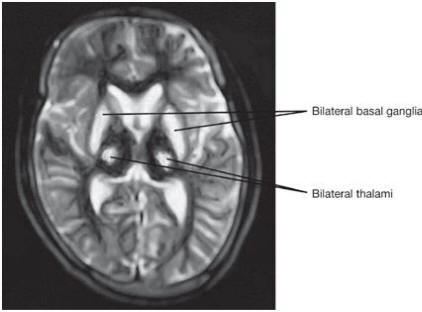
Hyperintensities in the bilateral basal ganglia and thalami
shown by T2-weighted MRI of the brain
What is the prognosis?
Early onset of the disease is worse than late onset in terms of prognosis. If the disorder is detected early and treated appropriately, an individual with WD can usually enjoy normal
health and a normal lifespan. If not treated, WD can cause severe brain damage, liver failure, and death. The disease requires lifelong treatment.
Some things have been said, yet so much more cannot be written about. See this message from God.
- Small Fiber neuropathy
- neurological effects of CIDP
- Colostruma
- SLE Home page
- Caveman Diet
- Iodine deficient diet
- Food additives
- No artificial sweetener in diet
- Vinegar Benefits'
- Loss of apetitite
- Breast cancer herbs
- The best lifestyle
- DeTox diet
- Avoid Gum
- Right Fat Diet
- chemicals in French fries
- Electrical Stimulation Therapy
- Magnets and ageing
- Cupping
- Schizophrenia research here to stay
- autoimmune dementia
- End To Parkinson
- Kamut Grain
- irregular periods
- Myasthenia diet
- cancer survivor
- Tomato as a medicine
- Prevent Osteoporosis
- Some rheumatic disorders
- Polymyositis