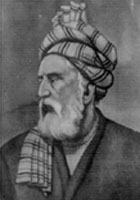
| Biography of
Hakim Abu al-Qasim Mansur Firdowsi
Firdowsi was born between the year 932 A. D. and 941
A. D. in a city of Khorasan called Tus (now part of
Iran). He is regarded as one of the major poets of
Khorasan and the author of the famous epic of Shah
Namah (The Book of Kings).
Not much is known about his early life except that
he was born in the city of Tus, Khorasan, and
belonged to a family who traditionally was involved
in agriculture (diqhani) and owned land. Some
sources indicate that his real name is not known and
Firdowsi is his pen name, derived from the word
Firdows which mean paradise. Moreover, some other
sources mentions his name to be Abul Qasem Mansur.
It is assumed that he had a considerable degree of
financial independence from the inheriting land and
its incoming revenue.
Firdowsi remained almost all of his life in Khorasan
except of a visit to Baghdad. He lived and traveled
extensively in different cities of Khorasan, such as
Balkh, Ghazna and cities of Northern Khorasan across
the Amu Darya (Oxus River). Whether he was settled
in a city or was in travel he would research and
imbibe the pre- Arab values of Khorasanians
particularly from the ordinary dihqan class and
Samanid rulers who had great attachment to their own
pre-Arab glories, greatness and independence.
By age thirty, he had developed a good understanding
of the past history of Iran. Familiar with the
consequences of the Arab conquest of his homeland,
he sought to safeguard Iranian heritage against
impending assaults by the Turks of Central Asia.
Toward this end, he studied the chronicles of
Mazandaran, Sistan, Balkh, Bukhara, and Khutan, as
well as the oral traditions that had developed over
centuries around the ancient culture. These included
discussions of immortality, the divine right of
kings, knowledge, justice, heroism, vengeance,
deceit, and black magic. By age forty, Firdowsi was
ready to versify the entire account made available
to him by a friend.
Firdowsi began composing the epic of Shah Nameh in
the year 975 A. D. and finally it was completed in
the year 1010 A. D. after 35 years. It contains
around sixty thousands couplets. While the
chronicles and the documents that Firdowsi used have
all but vanished, however, his rendition of them in
verse remains.
Regarding the veracity of his stories, he cautions
the reader not to relegate them to the realm of
"lies and myths." Rather, he insists, his stories
must be understood to contain both knowledge and
mysteries:
"Deem not these legends lying fantasy,
As if the world were always in one stay,
For most accord with sense,"
The epic is based, Firdowsi states, on ancient
accounts scattered in the hands of mu'bads in
different regions of Iran. A champion dihqan, he
continues, collected these stories by consulting
aged mu'bads of various climes and compiled this
book:
"In the days gone by
There was an Epic Cycle spread broadcast
Among the learned archmages, and at last
A certain paladin, of rustic birth,
A man of courage, wisdom, rank, and worth,
An antiquary, one who ransacked earth
For any legends of the ages past,
Intent on learning what might yet be known,
Called hoar archmages out of every clime,
To ask about the annals of the throne,
The famed successful heroes of old time" ..
|