Nerve Cell Physiology-2
The potassium channels then open, and, because there is more potassium inside the membrane than outside, positively-charged potassium ions diffuse out. As these positive ions go out, the inside of the membrane once again becomes negative with respect to the outside.
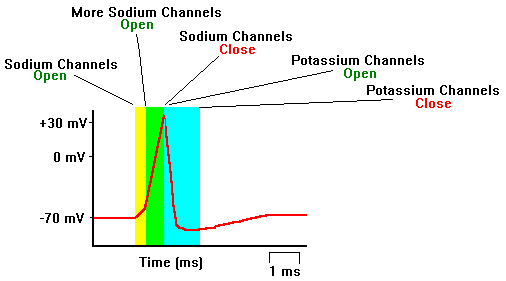
Threshold stimulus & potential
- Action potentials occur only when the membrane in stimulated
(depolarized) enough so that sodium channels open completely. The minimum
stimulus needed to achieve an action potential is called the threshold
stimulus.

- The threshold stimulus causes the membrane potential to become less negative (because a stimulus, no matter how small, causes a few sodium channels to open and allows some positively-charged sodium ions to diffuse in).
- If the membrane potential reaches the threshold potential (generally 5 - 15 mV less negative than the resting potential), the voltage-regulated sodium channels all open. Sodium ions rapidly diffuse inward, & depolarization occurs.
All-or-None Law - action potentials occur maximally or not at all. In
other words, there's no such thing as a partial or weak action potential. Either
the threshold potential is reached and an action potential occurs, or it isn't
reached and no action potential occurs.
Refractory periods:
ABSOLUTE -
- During an action potential, a second stimulus will not produce a second action potential (no matter how strong that stimulus is)
- corresponds to the period when the sodium channels are open (typically just a millisecond or less)
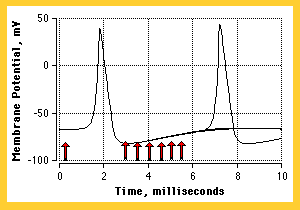
RELATIVE -
- Another action potential can be produced, but only if the stimulus is greater than the threshold stimulus
- corresponds to the period when the potassium channels are open (several milliseconds)
- the nerve cell membrane becomes progressively more 'sensitive' (easier to stimulate) as the relative refractory period proceeds. So, it takes a very strong stimulus to cause an action potential at the beginning of the relative refractory period, but only a slightly above threshold stimulus to cause an action potential near the end of the relative refractory period.
Impulse conduction - an impulse is simply the movement of action potentials along a nerve cell. Action potentials are localized (only affect a small area of nerve cell membrane). So, when one occurs, only a small area of membrane depolarizes (or 'reverses' potential). As a result, for a split second, areas of membrane adjacent to each other have opposite charges (the depolarized membrane is negative on the outside & positive on the inside, while the adjacent areas are still positive on the outside and negative on the inside). An electrical circuit (or 'mini-circuit') develops between these oppositely-charged areas (or, in other words, electrons flow between these areas). This 'mini-circuit' stimulates the adjacent area and, therefore, an action potential occurs. This process repeats itself and action potentials move down the nerve cell membrane. This 'movement' of action potentials is called an impulse.

Conduction Velocity:
- Impulses typically travel along neurons at a speed of anywhere from 1 to 120 meters per second
- The speed of conduction can be influenced by:
- The diameter of a fiber (Greater the diameter faster the conduction).
- Temperature ( Colder the temperature slower the conduction) .
- The presence or absence of myelin ( Myelin acts as a Turbocharger)

Schwann cells are located at regular intervals along the process (axons and, for some neurons, dendrites) & so a section of a myelinated axon would look like this: