A Polio vaccine story
Children's illness not due to polio drops:
Seven children were admitted to hospital five days after being
administered pulse polio drops, while 64 others were taken ill in
Assam's Sonitpur district, even as authorities denied media reports
that the illness was related to the vaccination programme undertaken
in the state on January 20.
Joint Director of Health,
Sonitpur, Dr Dhruba Hojai on Sunday said seven children were
admitted to the Dhekiajuli hospital on January 25, but five of them
were later released while two were still under treatment.
Hojai denied that these and 64 other children were taken ill
after being administered polio drops under the pulse polio
immunization programme.
Hojai claimed the illness of the children was not connected with the
programme, as they were suffering from diahorroea, fever and
dehydration when the dose was administered.
(does this mean dont give polio drops to children when they are
sick)
He admitted
that the health workers were only instructed to administer the doses
and were in no position to check whether any child was suffering
from any disease.
The pulse polio programme had received a setback in the state after
23 children died in November after being administered the dose,
with the state human rights commission holding the Assam government
and the United Nations International Children's Emergency Fund.
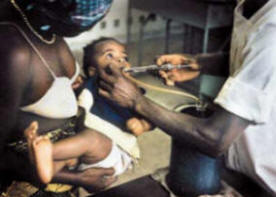
The longer Edward Hooper studied the maps, the more he believed he
had solved one of the great mysteries of modern medicine.
He
had marked the Central African villages that were home to some of
the earliest known cases of AIDS. In a striking number of cases,
those villages were near the rural clinics where a U.S. company had
tested one of the world's first oral polio vaccines in the late
1950s.
For nearly 10 years, the former BBC reporter had been
investigating the possibility that something had gone terribly wrong
during the vaccination campaign --
that a monkey virus had contaminated the experimental polio vaccine
and ignited the global AIDS epidemic.
It was a theory so
troubling -- and some say so riddled with flaws -- that for years
respected science journals refused to even acknowledge it. But when
Hooper's book "The River" was published in late 1999, laying out
evidence for the hypothesis in meticulous detail, the international
scientific community could no longer ignore it.
Last fall, the
Royal Society of London, the prestigious scientific academy once
presided over by Sir Isaac Newton, called the first-ever conference
on the origin of the AIDS epidemic, primarily to address the theory
advanced by Hooper, a non-scientist who had majored in American
literature in mily: college.
The two-day conference drew
some of the most prominent medical researchers in the world. By the
time the historic showdown concluded, other rival and conflicting
theories would emerge -- including one involving the widespread use
of contaminated needles -- and Hooper would not be the only one to
ask the chilling question:
Did modern medicine inadvertently
cause one of the greatest scourges of the 20th century?
The
answer will have significance for generations to come. More than 57
million people have been stricken with AIDS, 22 million have died,
and 15,000 new infections are occurring daily. And experts now fear
there are other lethal viruses out there in the "hot zone."
If
AIDS did sweep the globe because of human error, perhaps the next,
more devastating epidemic can be prevented.
The
Epidemic Emerges
Los Angeles, 1981
In
the spring of 1981, two doctors in Los Angeles reported to the
Centers for Disease Control in Atlanta that they had discovered a
rare kind of pneumonia caused by the bacteria, Pneumocystis carinii,
in five recent patients. All five were gay men. Two of them had
unexpectedly died.