At CIDPUSA we have reversed prostate cancer,
prostate enlargement
in many people with this
simple protocol. In even
advanced cases prostate cancer was
reversed without surgery or
radiation.
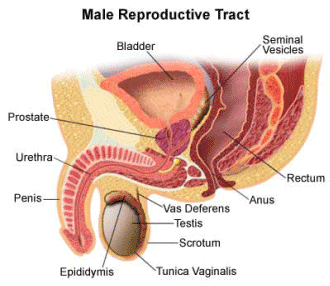
There are three steps to do
Disclaimer: Information
by cidpusa.org does not constitute a medical opinion, no remedy or
information provided should be used without consulting a physician,
and other legal issues..
One : Get rid of
Mycoplasma
that is causing the cancer you
can either use
Doxycycline 100 mg
daily or use a Hulda clark zapper or
a Tens unit on your wrists daily for
a year.
Second part is to take
Vitamin-D3 2000 units daily for a
year.
Third part is to use
Turmeric
one half teaspoon in a glass of milk
at night for a year.
Please aso read the
Hydrogen peroxide
page and our diet page .
Every person has improved read
our cancer book for details.
Cancer prevention and reversal
E-Book
Above is a
complete cure of cancer, patients on
this protocol who were going to have
prostate removal in Kaiser did not
need surgery as the prostate had
shrunken.
See the
anti cancer foods and
Regan's cancer treatment just with
hot water amazing.
Can Selenium
Stop Prostate Cancer?
Prostate cancer is the most
commonly diagnosed cancer among
American men, according to the
Washington, D.C.-based National
Cancer Institute (NCI). However, the
bulk of these cancers remain latent,
and only a small number progress to
cause illness or death. In 1997, NCI
estimated 210,000 new cases were
diagnosed and 42,000 men died as a
result of their cancer. A recent
study suggests eating foods rich in
the trace mineral selenium organ
meats, seafood and whole grains may
help men reduce their risk of
advanced prostate cancer.1
To determine this, researchers
from Harvard University studied
33,737 male health professionals,
all of whom provided toenail
clippings that were stored for later
analysis. Because the selenium
content of toenails is a good
indicator of selenium status, the
stored material provided an
opportunity to match selenium status
before diagnosis with a later
occurrence of prostate cancer. The
study began in 1987 as part of a
prostate cancer study in which
selenium was not
supplemented.
Participants filled out
questionnaires during the course of
the study, and all new cases of
prostate cancer were recorded. From
1989 through 1994, the group
reported 181 new cases of advanced
prostate cancer. Each case was
matched with a control subject (one
who did not have prostate cancer) of
the same age and smoking status. The
toenail samples of both the cases
and controls were analyzed for
selenium.
Results showed the mean toenail
selenium level was significantly
higher in control subjects than in
cancer subjects. When subjects in
the highest 20 percent for selenium
status were compared with those in
the lowest 20 percent, those with
the highest selenium status were
half as likely to get prostate
cancer as those with the lowest
levels.
While this study shows an
association between low selenium
levels and occurrence of prostate
cancer, it does not show that the
relationship is causal. Additional
well-planned, controlled studies are
needed to show whether raising
selenium levels can protect against
this disease. However, this report
adds another strong piece of
supportive evidence. S.B.
References
continue to next page of prostate
cancer
1. Yoshizawa
K, etal. Study of prediagnostic
selenium level in toenails and the
risk of advanced prostate cancer.
J Nat Canc Inst 1998 Aug
19;90(16):1219-.