| |
 |
Addison Disease
Adrenal Failure |
|
|
| |
Addison's disease is an endocrine or hormonal disorder
that occurs in all age groups and afflicts men and women
equally. The disease is characterized by weight loss, muscle
weakness, fatigue, low blood pressure, and sometimes
darkening of the skin in both exposed and nonexposed parts
of the body. Addison's disease occurs when the adrenal
glands do not produce enough of the hormone cortisol and, in
some cases, the hormone aldosterone. The disease is also
called adrenal insufficiency, or hypocortisolism.
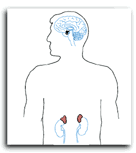
Cortisol
Cortisol is normally produced by the adrenal glands,
located just above the kidneys. It belongs to a class of
hormones called glucocorticoids, which affect almost every
organ and tissue in the body. Scientists think that cortisol
has possibly hundreds of effects in the body. Cortisol's
most important job is to help the body respond to stress.
Among its other vital tasks, cortisol
- helps maintain blood pressure and cardiovascular
function
- helps slow the immune system's inflammatory response
- helps balance the effects of insulin in breaking
down sugar for energy
- helps regulate the metabolism of proteins,
carbohydrates, and fats
- helps maintain proper arousal and sense of
well-being
Because cortisol is so vital to health, the amount of
cortisol produced by the adrenals is precisely balanced.
Like many other hormones, cortisol is regulated by the
brain's hypothalamus and the pituitary gland, a bean-sized
organ at the base of the brain. First, the hypothalamus
sends "releasing hormones" to the pituitary gland. The
pituitary responds by secreting hormones that regulate
growth and thyroid and adrenal function, and sex hormones
such as estrogen and testosterone. One of the pituitary's
main functions is to secrete ACTH (adrenocorticotropin), a
hormone that stimulates the adrenal glands. When the
adrenals receive the pituitary's signal in the form of ACTH,
they respond by producing cortisol. Completing the cycle,
cortisol then signals the pituitary to lower secretion of
ACTH.
Aldosterone
Aldosterone belongs to a class of hormones called
mineralocorticoids, also produced by the adrenal glands. It
helps maintain blood pressure and water and salt balance in
the body by helping the kidney retain sodium and excrete
potassium. When aldosterone production falls too low, the
kidneys are not able to regulate salt and water balance,
causing blood volume and blood pressure to drop.
|
Causes
|
Failure to produce adequate levels of cortisol can occur
for different reasons. The problem may be due to a disorder
of the adrenal glands themselves (primary adrenal
insufficiency) or to inadequate secretion of ACTH by the
pituitary gland (secondary adrenal insufficiency).
Primary Adrenal Insufficiency
Addison's disease affects about 1 in 100,000 people. Most
cases are caused by the gradual destruction of the adrenal
cortex, the outer layer of the adrenal glands, by the body's
own immune system. About 70 percent of reported cases of
Addison's disease are caused by autoimmune disorders, in
which the immune system makes antibodies that attack the
body's own tissues or organs and slowly destroy them.
Adrenal insufficiency occurs when at least 90 percent of the
adrenal cortex has been destroyed. As a result, often both
glucocorticoid (cortisol) and mineralocorticoid
(aldostertone) hormones are lacking. Sometimes only the
adrenal gland is affected, as in idiopathic adrenal
insufficiency; sometimes other glands also are affected, as
in the polyendocrine deficiency syndrome.
Polyendocrine Deficiency Syndrome
The polyendocrine deficiency syndrome is classified into
two separate forms, referred to as type I and type II.
Type I occurs in children, and adrenal insufficiency may
be accompanied by
- underactive parathyroid glands
- slow sexual development
- pernicious anemia
- chronic candida infections
- chronic active hepatitis
- hair loss (in very rare cases)
Type II, often called Schmidt's syndrome, usually
afflicts young adults. Features of type II may include
- an underactive thyroid gland
- slow sexual development
- diabetes
- vitiligo
- loss of pigment on areas of the skin
Scientists think that the polyendocrine deficiency
syndrome is inherited because frequently more than one
family member tends to have one or more endocrine
deficiencies.
Tuberculosis
Tuberculosis (TB), an infection which can destroy the
adrenal glands, accounts for about 20 percent of cases of
primary adrenal insufficiency in developed countries. When
adrenal insufficiency was first identified by Dr. Thomas
Addison in 1849, TB was found at autopsy in 70 to 90 percent
of cases. As the treatment for TB improved, however, the
incidence of adrenal insufficiency due to TB of the adrenal
glands has greatly decreased.
Other Causes
Less common causes of primary adrenal insufficiency are
- chronic infection, mainly fungal infections
- cancer cells spreading from other parts of the body
to the adrenal glands
- amyloidosis
- surgical removal of the adrenal glands
Secondary Adrenal Insufficiency
This form of adrenal insufficiency is much more common
than primary adrenal insufficiency and can be traced to a
lack of ACTH. Without ACTH to stimulate the adrenals, the
adrenal glands' production of cortisol drops, but not
aldosterone. A temporary form of secondary adrenal
insufficiency may occur when a person who has been receiving
a glucocorticoid hormone such as prednisone for a long time
abruptly stops or interrupts taking the medication.
Glucocorticoid hormones, which are often used to treat
inflammatory illnesses like rheumatoid arthritis, asthma, or
ulcerative colitis, block the release of both
corticotropin-releasing hormone (CRH) and ACTH. Normally,
CRH instructs the pituitary gland to release ACTH. If CRH
levels drop, the pituitary is not stimulated to release
ACTH, and the adrenals then fail to secrete sufficient
levels of cortisol.
Another cause of secondary adrenal insufficiency is the
surgical removal of benign, or noncancerous, ACTH-producing
tumors of the pituitary gland (Cushing's disease). In this
case, the source of ACTH is suddenly removed, and
replacement hormone must be taken until normal ACTH and
cortisol production resumes.
Less commonly, adrenal insufficiency occurs when the
pituitary gland either decreases in size or stops producing
ACTH. These events can result from
- tumors or infections of the area
- loss of blood flow to the pituitary
- radiation for the treatment of pituitary tumors
- surgical removal of parts of the hypothalamus
- surgical removal of the pituitary gland
|
Symptoms
|
The symptoms of adrenal insufficiency usually begin
gradually. Characteristics of the disease are
- chronic, worsening fatigue
- muscle weakness
- loss of appetite
- weight loss
About 50 percent of the time, one will notice
Other symptoms include
- low blood pressure that falls further when standing,
causing dizziness or fainting
- skin changes in Addison's disease, with areas of
hyperpigmentation, or dark tanning, covering exposed and
nonexposed parts of the body; this darkening of the skin
is most visible on scars; skin folds; pressure points
such as the elbows, knees, knuckles, and toes; lips; and
mucous membranes
Addison's disease can cause irritability and depression.
Because of salt loss, a craving for salty foods also is
common. Hypoglycemia, or low blood glucose, is more severe
in children than in adults. In women, menstrual periods may
become irregular or stop.
Because the symptoms progress slowly, they are usually
ignored until a stressful event like an illness or an
accident causes them to become worse. This is called an
addisonian crisis, or acute adrenal insufficiency. In most
cases, symptoms are severe enough that patients seek medical
treatment before a crisis occurs. However, in about 25
percent of patients, symptoms first appear during an
addisonian crisis.
Symptoms of an addisonian crisis include
- sudden penetrating pain in the lower back, abdomen,
or legs
- severe vomiting and diarrhea
- dehydration
- low blood pressure
- loss of consciousness
Left untreated, an addisonian crisis can be fatal.
|
Diagnosis
|
In its early stages, adrenal insufficiency can be
difficult to diagnose. A review of a patient's medical
history based on the symptoms, especially the dark tanning
of the skin, will lead a doctor to suspect Addison's
disease. A diagnosis of Addison's disease is made by
laboratory tests. The aim of these tests is first to
determine whether levels of cortisol are insufficient and
then to establish the cause. X-ray exams of the adrenal and
pituitary glands also are useful in helping to establish the
cause. |
ACTH Stimulation Test
|
This is the most specific test for diagnosing Addison's
disease. In this test, blood cortisol, urine cortisol, or
both are measured before and after a synthetic form of ACTH
is given by injection. In the so-called short, or rapid,
ACTH test, measurement of cortisol in blood is repeated 30
to 60 minutes after an intravenous ACTH injection. The
normal response after an injection of ACTH is a rise in
blood and urine cortisol levels. Patients with either form
of adrenal insufficiency respond poorly or do not respond at
all. |
CRH Stimulation Test
|
When the response to the short ACTH test is abnormal, a
"long" CRH stimulation test is required to determine the
cause of adrenal insufficiency. In this test, synthetic CRH
is injected intravenously and blood cortisol is measured
before and 30, 60, 90, and 120 minutes after the injection.
Patients with primary adrenal insufficiency have high ACTHs
but do not produce cortisol. Patients with secondary adrenal
insufficiency have deficient cortisol responses but absent
or delayed ACTH responses. Absent ACTH response points to
the pituitary as the cause; a delayed ACTH response points
to the hypothalamus as the cause. In patients suspected of
having an addisonian crisis, the doctor must begin treatment
with injections of salt, fluids, and glucocorticoid hormones
immediately. Although a reliable diagnosis is not possible
while the patient is being treated for the crisis,
measurement of blood ACTH and cortisol during the crisis and
before glucocorticoids are given is enough to make the
diagnosis. Once the crisis is controlled and medication has
been stopped, the doctor will delay further testing for up
to 1 month to obtain an accurate diagnosis. |
Other Tests
|
Once a diagnosis of primary adrenal insufficiency has
been made, x-ray exams of the abdomen may be taken to see if
the adrenals have any signs of calcium deposits. Calcium
deposits may indicate TB. A tuberculin skin test also may be
used. If secondary adrenal insufficiency is the cause,
doctors may use different imaging tools to reveal the size
and shape of the pituitary gland. The most common is the CT
scan, which produces a series of x-ray pictures giving a
cross-sectional image of a body part. The function of the
pituitary and its ability to produce other hormones also are
tested.
|
Treatment
|
Treatment of Addison's disease involves replacing, or
substituting, the hormones that the adrenal glands are not
making. Cortisol is replaced orally with hydrocortisone
tablets, a synthetic glucocorticoid, taken once or twice a
day. If aldosterone is also deficient, it is replaced with
oral doses of a mineralocorticoid called fludrocortisone
acetate (Florinef), which is taken once a day. Patients
receiving aldosterone replacement therapy are usually
advised by a doctor to increase their salt intake. Because
patients with secondary adrenal insufficiency normally
maintain aldosterone production, they do not require
aldosterone replacement therapy. The doses of each of these
medications are adjusted to meet the needs of individual
patients. During an addisonian crisis, low blood pressure,
low blood glucose, and high levels of potassium can be life
threatening. Standard therapy involves intravenous
injections of hydrocortisone, saline (salt water), and
dextrose (sugar). This treatment usually brings rapid
improvement. When the patient can take fluids and
medications by mouth, the amount of hydrocortisone is
decreased until a maintenance dose is achieved. If
aldosterone is deficient, maintenance therapy also includes
oral doses of fludrocortisone acetate.
|
Special Problems
|
Surgery
Patients with chronic adrenal insufficiency who need
surgery with general anesthesia are treated with injections
of hydrocortisone and saline. Injections begin on the
evening before surgery and continue until the patient is
fully awake and able to take medication by mouth. The dosage
is adjusted until the maintenance dosage given before
surgery is reached.
Pregnancy
Women with primary adrenal insufficiency who become
pregnant are treated with standard replacement therapy. If
nausea and vomiting in early pregnancy interfere with oral
medication, injections of the hormone may be necessary.
During delivery, treatment is similar to that of patients
needing surgery; following delivery, the dose is gradually
tapered and the usual maintenance doses of hydrocortisone
and fludrocortisone acetate by mouth are reached by about 10
days after childbirth.
|
Patient Education
|
A person who has adrenal insufficiency should always
carry identification stating his or her condition in case of
an emergency. The card should alert emergency personnel
about the need to inject 100 mg of cortisol if its bearer is
found severely injured or unable to answer questions. The
card should also include the doctor's name and telephone
number and the name and telephone number of the nearest
relative to be notified. When traveling, a needle, syringe,
and an injectable form of cortisol should be carried for
emergencies. A person with Addison's disease also should
know how to increase medication during periods of stress or
mild upper respiratory infections. Immediate medical
attention is needed when severe infections, vomiting, or
diarrhea occur. These conditions can precipitate an
addisonian crisis. A patient who is vomiting may require
injections of hydrocortisone. People with medical problems
may wish to wear a descriptive warning bracelet or neck
chain to alert emergency personnel. A number of companies
manufacture medical identification products.
|
Suggested Reading
|
The following materials can be found in medical
libraries, many college and university libraries, and
through interlibrary loan in most public libraries.
Stewart PM. The adrenal cortex. In: Larsen P, ed.
Williams Textbook of Endocrinology. 10th ed.
Philadelphia: Saunders; 2003: 491–551.
Chrousos GP. Glucocorticoid therapy. In: Felig P, Frohman
L, eds. Endocrinology and Metabolism. 4th ed. New
York: McGraw-Hill; 2001: 609–632.
Miller W, Chrousos GP. The adrenal cortex. In: Felig P,
Frohman L, eds. Endocrinology and Metabolism. 4th ed.
New York: McGraw-Hill; 2001: 387–524.
Ten S, New M, Maclaren N. Clinical Review 130: Addison's
disease 2001. Journal of Clinical Endocrinology &
Metabolism. 2001;86(7):2909–2922.
Williams GH, Dluhy, RC. Disorders of the adrenal cortex.
In: Braunwald E, ed. Harrison's Principles of Internal
Medicine. 15th ed. New York: McGraw-Hill Professional;
2001: 2084–2105.
|
www.cidpusa.org
www.cidpusa.org/P/ivig.htm
http://www.cidpusa.org/disease.html
http://www.cidpusa.org/Lahore.html
|
|