God is our Guide                 Number 1 site for helping reverse diseases on Planet Earth
cidpUSA Foundation

 cidpusa.org   


      Home
      Diagnosis
      Treatment
      Pathology
      Variants
      CIDP info
      Fibromyalgia
      IVIG
      Diet anti-inflammatory
      Burning  Feet Home
      Services Page
      Chronic Fatigue
      Autoimmune diseases
      Prognosis
      Bible healing
      Celiac disease
Bible page

Autoimmune self attack

What is autoimmune

Autoimmune types

Autoimmune Guide

 Autoimmune-Epidemic

 Autoimmune & women

Autoimmunity secrets

Autoimmune inflammation

Auto-diseases plan

Autoimmune Risk

Autoimmune Rx

Autoimmune anemia

Autoimmune Ear

Autoimmune Thyroid

Autoimmune Fiber

Autoimmune Muscle

Autoimmunity summary

Autonomic Small Fiber

Myasthenia Holistic

Polymyositis

Dematomyositis

Poly Dermato

Myositis

Myasthenia alternative

Myofacial pain

Myopathy

Fibromyalgia

Inner Ear Disease AIED

 
  Natural Makeup
  Neck Pain
  Ocular Female diseases
  Chronic fatigue syndrome
  Osteoporosis
  Women Heart Attacks
  Breast Size & Disease
  Female Sex Disease
  PARKINSON
  Memory problems
  Breast Lymph Drainage
  Kidney stone Buster
 Bras cause breast cancer
  Skin repair Clinic
 Pandas
  Hepatitis


Risk of heart disease & stroke 

Depression and breast cancer

Kidney stone removal 

Alopecia general

Personality

Eye Clinic

Skin hair nail spa

Memory clinic

Depression & anxiety

Addiction  & Drug Rehab

Sexual  disorders Clinic

Parkinson Clinic

Epilepsy Clinic

Pain Clinic

Bone disorders clinic

Joint disorder clinic

Skin repair clinic

Gene Manipulation

Neurology Clinic

TMJ Clinic

Sex in autoimmune disease

Reduce  your weight

Antibiotics

 Want more sex

 Vitiligo 1

 Vitiligo 2

Eliminate risk of heart disease & stroke 

Memory clinic

Sex in autoimmune disease

Reduce weight

Drug reaction prevention

Prevent Osteoporosis

Some rheumatic disorders

Alopecia treatment

Bald Facts

Alopecia

Areata Alopecia

Hair chemicals

Hair Growth

Hair of dog technique

Hair rejuvenation

Nail Fungus

SESAME SEED OIL

Facial  cleaner

oil pulling

 Reading disorders

 Best New Diet

 DHEA Fountain of Youth

DHEA levels and cognitive functions

Parkinson

Diabetise-2

Do not give tots cold medicine 

neurological effects of CIDP

Body goes against the grain

Celiac disease Info

More on Celiac disease

Anemia and celiac disease

Home for autoimmune disorders, information about autoimmune diseases

 Sex clinic

Lahore Clinic page

Everything about IVIg, Home to IVIg

Home to autoimmune diseases, causes, treatment, cure, e-book

Fatty acids in autoimmune diseases

News

Multifocal neuropathy

Dermrmatomyositis

 
 Link to Articles

 www.cidpusa.org/P/ivig.htm


 Information on American Herbs

   Complete guide to alternative  treatment of autoimmune disease please read our e-book

See services section for help and contact information. continued from the  Brain Page of Nervous System Contents

Neurons and Nerves
neurotransmitter
The Brain & Spinal Cord
Cranial Nerves
Peripheral Nervous System
Autonomic Nervous System
Senses: Eye diagrams, Hearing, Smell, Taste, Taste & Tongue Sensation, Balance
Memory , Memory types, Creation of Memory,
Higher Functions
Altered States

[Top]

  • Altered States

    It is not possible to divide states of being into the neat categories of consciousness and unconsciousness. Too many curious and interesting states lie between, challenging a simple definition. These altered states of consciousness defy objective description because they are intensely personal. Nevertheless, these experiences, which range from the mild distraction of a daydream to wild, drug-induced hallucinations, can have certain common characteristics related to the change of perceptions of the self and the outside world. The term "altered states" covers a number of phenomena. Some arise naturally and
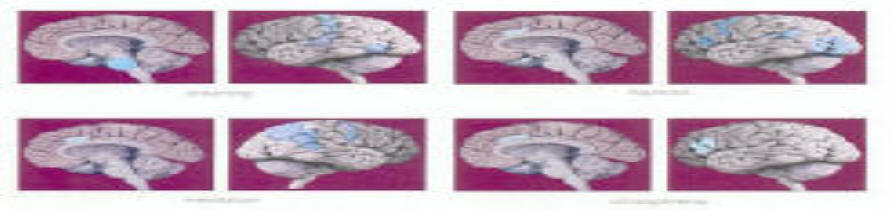
    Altered States automatically (dreaming, for example, is thought to be common to all mammals). Others are attained through learned techniques such as meditation. Some are induced by drugs. Other still - the vision and trance states - are highly controversial, and many people doubt their existence. To understand altered states one must assess subjective accounts of what it is like to "be in" these states, along with objective research that tries to identify their physiological basis and effects. Figure 33 shows the brain scan for some of the altered states listed below.

    Figure 33 Altered States
    [view large image]

     
    Dreaming Cat
  • Dreaming - Vivid visual dreams light up the visual cortex; nightmares trigger activity in the amygdala and the hippocampus flares up from time to time to replay recent events. The areas, which seem to be most commonly active are the pathways carrying alerting signals from the brainstem and the auditory cortex; supplementary motor area and visual association areas - all of which produce the "virtual reality" effect of dreaming. Activity is decreased in the dorsolateral prefrontal cortex, the area of waking thought and reality testing (Figure 33). Studies have shown that dreaming sleep occurs in a wide range of animal species. Figure 34 shows a dreaming cat. When its pons is surgically removed to permit movement during REM
  • Figure 34 Dreaming Cat
    [view large image]

    sleep, the very nice cat becomes a vicious tiger when it is dreaming and throws itself at imaginary prey.

     
    Daydream
  • Daydream - Many surveys suggest that ordinary men and women, who are neither disturbed nor neurotic, spend a large part of each day in some sort of fantasy, reverie or daydream. This kind of quick fantasy rarely has a structured narrative. It is the moment when we stop paying attention to what we are seeing and hearing and switch into an inner theatre of the imagination where we can play at wish fulfillment (Figure 35). But there are other fantasies qualitatively different from these "wouldn't it be nice if ..." stories. These are sustained fantasies, which often seem to have been crafted, worked and reworked to meet some more profound psychological need. When one daydreams, normal inhibitions are bypassed. The
  • Figure 35 Daydream
    [view large image]

    evidence of the rather macabre biographies of serial killers shows that they had frequently recurring violent fantasies before they turned to murder.

     
    Meditation
  • Meditation - One function of consciousness is to knit together our sense of self-identity. But many religious traditions believe that enlightenment can be achieved only by breaking the shackles of self and attaining "purer" states of consciousness through meditation (Figure 36). As well as its psychological benefits, the meditative state has marked physiological effects - these phenomena are measurable and reliably repeatable, and thus are a suitable object of scientific study. Such studies have revealed some remarkable effects: meditation can lower a subject's metabolic rate, decreasing blood pressure, pulse rate and muscle tension. One study shows that the subject could reduce his oxygen intake to one-third of the normal resting state. Scans of people in a self-induced state of "passive attention" have
  • Figure 36 Meditation
    [view large image]

    been shown to "turn off" areas of the brain normally associated with seeking stimuli, including the parietal, anterior and premotor cortexes (Figure 33).


    Hypnosis
  • Hypnosis - Modern studies show that the brain waves of hypnotized subjects are much like those of the waking state. When subjects are hypnotized, they can speak, walk and carry out instructions. Yet there are some noticeable changes from normal consciousness: attention becomes very selective, with the subject ignoring everything but the hypnotist's voice; the subject rarely initiates thought or activity, but waits for suggestions from the hypnotist; and fantastic ideas or situations are more readily accepted as reality. It is almost as if the willing, relaxed subject relinquishes control over part of his or her consciousness to the hypnotist. The classic method of hypnotism is to put a subject into a relaxed frame of mind and ask him or her to concentrate on an object, such as a swinging pocket watch (Figure 37). Brain scans (Figure 33) show increased activity during hypnosis in the motor and sensory
  • Figure 37 Hypnosis
    [view large image]

    areas suggesting heightened mental imagery. Increased blood flow in the right anterior cingulate cortex suggests that attention is focused on internal events. The brain activity seen in this state is quite different from that seen in normal waking or sleeping.


    Fantasy
  • Sexual fantasy - This is the ability to use our imaginations erotically. It is found that people spend a surprising amount of time thinking about sex. There are vast cultural differences in what different societies consider acceptable material for sexual fantasy and fetishes. The Victorians considered fetish to be shocking and dangerous, the true dark side of sexuality; while the Freudian view treats fetishism as the result of linking unresolved childhood drives to object that seems "safe" such as the high-heeled shoe. Many therapists now consider that it is perfectly normal to have sexual fantasies, and some even believe that they can be used to achieve a more fulfilling sex life. Research into sexual fantasies is complicated and must rely on what patients report to their therapists, but some studies have found links with childhood events - either sexual violence or a strict, repressed upbringing. There is an obvious distinction between fantasy and action - a fantasy does not harm others. However, some people who have
  • Figure 38 Fantasy
    [view large image]

    fantasies that involves inflicting pain to themselves or others (such as to the cat in Figure 38) claim that they feel compelled to act them out. Sometimes people with less extreme fantasies also choose to turn them into realities such as in the form of cross dressing.


    Drug Addiction
  • Addiction - Drug addiction is caused by a similar train of events to hunger. However, unlike most types of food, addictive drugs cause changes in the receptors to which they bind, making them less sensitive. This creates tolerance and addiction. Most addictive drugs work by altering levels of neurotransmitters in the brain's reward circuitry centered on the limbic areas. Other brain areas are also involved and each type of drug works in a slightly different way to produce its characteristic effects. Opiates are drugs derived from the dried resin of the opium poppy (Figure 39), or synthetic versions of these chemicals, such as heroin, codeine and morphine. All
  • Figure 39 Drug Addiction
    [view large image]

    have been used medicinally at some time for their pain-killing properties. They are used illegally for similar reasons: heroin gives the user a "high", reducing anxiety and producing a sense of temporary well-being.


  • Schizophrenia (shattered mind) - There is evidence to suggest that genetic vulnerability and environmental stressors can act in combination to cause schizophrenia. Some researchers estimate schizophrenia to be highly heritable. But a recent review of the genetic evidence has suggested only a 28% chance of one identical twin developing schizophrenia if the other already has it. A recent study listed seven genes as likely to be involved in the inheritance of schizophrenia or the risk of developing the disease. One of these genes known as COMT is involved in encoding the dopamine catabolic enzyme. This is interesting because of the known link between dopamine function, psychosis, and schizophrenia. There is considerable evidence indicating that stressful life events cause or trigger schizophrenia psychosis. Childhood experiences of abuse or trauma have also been implicated as risk factors for a diagnosis of schizophrenia later in life. There is also consistent evidence that negative attitudes towards individuals with schizophrenia can have a significant adverse impact. In particular, critical comments, hostility, and intrusive or controlling attitudes from family members have been found to correlate with a higher risk of relapse in schizophrenia across cultures. Factors such as poverty and discrimination also appear to be involved in increasing the risk of schizophrenia or
    Schizophrenia schizophrenia relapse, perhaps due to the high levels of stress they engender. The disease is frequently accompanied by paranoia and delusions. Some may experience extremely bizarre hallucinations. Ironically, while some areas of the schizophrenic brain may be dead, in other ways the sufferer's brain is overactive. Most schizophrenics appear to have an excess of dopamine in the brain, the neurons become overloaded and relay inappropriate messages (see Figure 40 for a modern view). Lack of activity in the frontal lobes is a feature of states of mind in which consciousness is disturbed. This might account for the state's common reduction in planned or spontaneous behavior and social withdrawal. The anterior cingulate cortex - thought to distinguish between external and internal stimuli - is also underactive (Figure 33), which may be one reason schizophrenics confuse their own thoughts with outside voices.

    Figure 40 Schizophrenia
    [view large image]


    Recently in 2006, it is found that those with mutations in the PCM1 gene had a significantly lower volume of grey matter in their orbitofrontal cortex resulting in poor judgement, inappropriate social behaviour and not keeping themselves clean. PCM1 plays a role in cell division, which in the brain occurs more actively at adolescence - an age at which schizophrenia is commonly diagnosed.

     
  • Dementia - Dementia is used to describe the organic deterioration of the brain that affects the elderly. The main, but not sole, form of dementia is Alzheimer's disease, and 25 percent of people who live to be older than 85 will show some symptoms. One of the hallmarks of Alzheimer's disease is the accumulation of amyloid plaques between neurons in the brain. Amyloid is a general term for protein fragments that the body produces normally. In a healthy brain, these protein fragments would be broken down and eliminated. In Alzheimer's disease, the fragments accumulate to form hard, insoluble plaques (see Figure 41). Neurofibrillary tangles consist of insoluble twisted fibers that are found inside of the brain's cells. They primarily consist of a protein called tau, which forms part of a structure called a microtubule. The microtubule helps transport nutrients and other important substances from one part of the nerve cell to another. In Alzheimer's disease the tau protein is abnormal and the microtubule structures collapse (see Figure 41). There is an overall shrinkage of brain tissue as Alzheimer's disease progresses. In addition, the ventricles are noticeably enlarged. In the early stages of Alzheimer's disease, short-term memory begins to decline when the cells in the hippocampus, degenerate (see Figure 41). The ability to perform routine tasks also
    Dementia declines. As Alzheimer's disease spreads through the cerebral cortex, judgment declines, emotional outbursts may occur and language is impaired. Progression of the disease leads to the death of more nerve cells and subsequent behavior changes, such as wandering and agitation. The ability to recognize faces and to communicate is completely lost in the final stages. Patients lose bowel and bladder control, and eventually need constant care. This stage of complete dependency may last for years before the patient dies. The average length of time from diagnosis to death is 4 to 8 years, although it can take 20 years or more for the disease to run its course.

    Figure 41 Alzheimer's Disease
    [view large image]

     
  • Vision - It is virtually impossible to carry out research into visions in the laboratory, because they do not happen on demand; as a result, the only evidence that visions do exist is the accounts of those people who have experienced them. Vision may occur in response to stress. They are often central to religious experience. Out-of-body experiences are not restricted to religious practices: they seem to occur in response to some kind of emergency situation. This is the case with near-death
    Vision experiences. There have been thousands of reports of near-death experiences, many noting the same types of sensations. Subjects feel as though they have left their bodies. Some people report travelling down a tunnel toward a bright light (Figure 42), where benevolent presences wait. Scientists have been unable to explain them conclusively. Some physiologists have suggested that hypoxia, or low oxygen levels in the brain, might cause a consistent pattern of hallucination in all sufferers. Other scientists argue

    Figure 42 Vision
    [view large image]

    that the experience stems from an acute bout of "REM intrusion" into the partially awakening state (in time of extreme stress) similar to narcolepsy - a neurological disorder characterised by uncontrollable bouts of sleep that can cause elaborate hallucinations and, sometimes, out-of-body experiences.


    The challenge of finding an ideal model animal in which a physical basis of memory formation might be revealed was taken up in the 1960s by E. R. Kandel, who eventually received the Nobel Prize in Physiology or Medicine in 2000 for his efforts on investigating the nervous system with Aplysia. The Aplysia did not share the prize, but his daughter Minouche at the age of seven has written a poem to enshrine the animal:

     
    A Poem An aplisa is like a squishy snail.
    In rain, in snow, in sleet, in hail.
    When it is angry, it shoots out ink.
    The ink is purple, it's not pink.
    An aplisa cannot live on land.
    It doesn't have feet so it can't stand.
    It has a very funny mouth.
    And in winter it goes to the south.
     

    [view large image]

     
  •   

       World Wide Consultation by Internet


    Tremor

    Top Foods

    Treatment of Myasthenia

    Trends in medicine 

    Ulcerative colitis 

    Ultrasound

    Everything about IVIg, Home to IVIg

    Fatty acids in autoimmune diseases

    Small fiber neuropathy 

    Depression and breast cancer

    Dermatomyositis

    Fighting with spouse gets good results!

    Vitamin D  deficiency causes high BP

     Mobile phone Use Increases Tumour Risk

    New Psoriasis Rx       LasiK Dangers

    No cold meds to kids, says FDA

    Calcium supplements cause stroke in women

    Vitamin D extends life   Breast Size & disease

    More Young Women Dying Of Heart Disease

    By pass heart surgery

     Reverse Chronic Fatigue syndrome & Fibromyalgia, 


    BPA in infant bottles a concern

    Want more sex

     Boy or Girl   Autism & Mercury

     Before getting child vaccination read this

     Parents rejecting dangerous vaccine 

    Botox causes deaths also in children

    Autoimmune reaction kills teenager in breast surgery

    Parkinson Prevention    Aids Vaccine alert

    Folate Deficiency Triples Risk of Dementia

    DHEA levels and cognitive functions

    SESAME SEED OIL

    Facial  cleaner

     Quran page