In God We trust

cidpUSA Foundation


 Home
Diagnosis
Treatment
Pathology
Variants
CIDP info
GBS
IVIG
Diet
FAQ
Celiac Disease
Fibromyalgia
Autoimmune diseases
Bible Healing
Chronic fatigue
IVIg  


Quranic Shifa

  Natural Makeup
  Neck Pain
  Ocular Female diseases
  Chronic fatigue syndrome
  Osteoporosis
  Women Heart Attacks
  Breast Size & Disease
  Female Sex Disease
  PARKINSON
  Memory problems
  Breast Lymph Drainage
  Kidney stone Buster
 Bras cause breast cancer
  Skin repair Clinic
 Pandas
  Hepatitis
  Clinics of Excellence

Autoimmune EAR

Kidney stone removal

Skin hair nail spa Lahore

Eliminate risk of heart disease & stroke 

Memory clinic

Depression & anxiety

Private treatment of addiction  & Drug Rehab

Sexual  disorders Clinic

Parkinson Clinic

Epilepsy Clinic

Pain Clinic

Bone disorders clinic

Joint disorder clinic

Skin repair clinic

Neurology Clinic

TMJ CLINIC

Reduce weight

Drug reaction prevention

Prevent Osteoporosis

Some rheumatic disorders

Chemicals

cupping

Immune deficiency

  Some rheumatic disorders

   Personality

  Alopecia treatment

  Hair of dog technique

neurological effects of CIDP

Body goes against the grain

dermatomyositis

Small fiber neuropathy 

 Vaccines and controversy

     Nervous System


                 Dont run after diamonds and Gold turn yourself into a Diamond or Gold read our e-book                  
                             Welcome to the CIDP  International organization     
                                             
Neurotransmitters Page

Nervous System


Contents

Neurons and Nerve

Neurons and Nerves
Neurotransmitter
The Brain
Spinal Cord
Peripheral Nervous System


Autonomic Nervous System
Senses: Sight, Senses, Smell, Taste, Sences, Senses
Memory
Higher Functions
Altered States


[Top]


Neurotransmitters

Neurotransmitters are chemicals that take a nerve signal across the synaptic gap (Figure 02a) between a sending neuron, and a receiving one. On the receiving neuron are receptors into which the neurotransmitters fit like a key in a lock. Once a neuro-transmitter is bound to its specific receptor, the likelihood of the receiving cell "firing" to send its own message is affected. The excitatory neurotransmitter-receptor systems make receiving cells more likely to fire, whereas the inhibitory systems make the
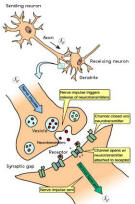
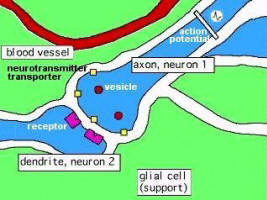
Synapse Neurotransmitters firing less likely (see Figure 29a). It all depends on the type of neurotransmitter. An individual nerve cell can possess both kinds of synaptic connections (with a total of about 50000 synapses on the surface) to other nerve cells. Only if the excitatory charges (positive charge) exceed a threshold does the target neuron starting a nerve impulse of its own and is known as transduction. Figure 02b shows the various components in the synapse. The vesicle contains the neuro-transmitters in the axon. The receptor is located on the surface of the dendrite to pick up the neuro-transmitters. The

Figure 02a Synapse
[view large image]

Figure 02b Neurotransmitter
[view large image]

transporter is for recycling un-used neutrotransmitters back into the axon; while the glial cell provides nutrition and support for the neurons.
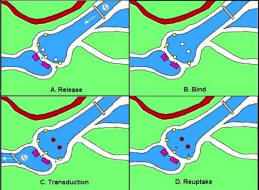
    Figure 02c shows the process of signal transmission across the synapse:
    Signal Transmission
  • Release - As the action potential comes down the axon, the calcium influx triggers an exocytosis of vesicles that contain the neurotransmitters, which are release into the synaptic cleft.
  • Bind - The neurotransmitters then drifts across , binds to the postsynaptic receptors.
  • Transduction - Depending on the integration of the excitatory and inhibitory inputs, the receiving dendrite may fire a signal for further transmission.
  • Reuptake - The neurotransmitter transporters remove the un-used neutrotransmitters in the synaptic gap back to the axon for re-use. This step is to prevent continuous stimulation of the postsynaptic neuron.
  • Figure 02c Signal Transmission
    [view large image]

    There are other ways to turn the signal off. One is simple diffusion into the extracellular space. Another way is to break down the neuro-transmitters with enzymes. Then there are the presynaptic autoreceptors
    (not shown), which terminate the release once a neutrotransmitter drifts back upstream and hits one of these receptors.
Since the neurotransmitters are more accessible than the neuron itself, it can be subjected to a lot of internal and external
Neuromodulator manipulations and abuses. Natural neuromodulators can aid the release or inhibit the reabsorption of neurotransmitters; still others delay the breakdown after reabsorption, leaving them in the tip to be reused by the next nerve impulse. Mood, pleasure, pain, and other mental states are determined by particular groups of neurons in the brain that use special sets of neurotransmitters and neuromodulators. For example, mood is strongly influenced by the neurotransmitter serotonin. It is believed that depression results from a shortage of serotonin. It is difficult to treat depression directly with serotonin because the chemical has too many other side effects. However, depression can be successfully treated with drugs that act as serotornin neuromodulators (Figure 02d). Prozac, the

Figure 02d Neuromodulator
[view large image]

world's top-selling antidepressant, inhibits the reabsorption of serotonin, increasing the amount in the synapse by slowing down its removal.

 
Drug Addiction When a neuron cell is exposed to a neurotransmitter for a prolonged period, it tends to lose its ability to respond to the stimulus with its original intensity. This is known as habituation, which is the result of the cell producing fewer receptors for that particular neurotransmitter. If someone takes a drug that acts as a neuromodulator (such as cocaine), which causes abnormally large amounts of neurotransmitter (dopamine in this case, Figure 02e) to remain in the synapses for long periods of time, it would generate more pleasure messages. Such action reduces the number of receptors in the neuron. Next time a higher dosage is required to maintain the pleasurable sensation. The result is addiction. Cocaine is a stimulant discovered in the mid-1800s. Many physicians at first considered it a miracle drug, prescribing it for all sorts of physical and mental ailments; it was even added to soft drinks. Today United States law forbids the importation, manufacture, and use of cocaine for nonmedical purposes, and even the medical use is extremely limited.

Figure 02e Drug Addiction
[view large image]

 
Types of Neurotransmitter Neurotransmitters can be broadly classified into two groups - the "classical", small molecule neurotransmitters and the relatively larger neuropeptide neurotransmitters. The small molecule types are mainly amino acids and amines (a nitrogen atom bonds to a maximum of three hydrocarbon groups). The larger neurotransmitters are combination of two or more amino acids joined by peptide bonds. Some fifty different neurotransmitters have been identified. The form of receptors for the neurotransmitters varies depending on the location in the body and produces different physiologic symptom. Understanding the numerous neurotransmitters, their receptors, locations and interactions with one another has been central to the design of medicines for mental illness. Figure 02f shows the effects of three major neurotransmitters and the mental states induced by their interactions.
Table 01 summarizes the properties of some important neurotransmitters.

Figure 02f Types of Neuro-transmitter [view large image]

 
Name Type Postsynaptic Effect Location(s) Function(s)
Dopamine Amine Excitatory Brain, smooth muscle Control arousal levels
Serotonin Amine Excitatory Brain, smooth muscle Effects on mood, sleep, pain, appetite
Noradrenaline Amine Excitatory Brain, smooth muscle Induce arousal, heighten mood
Acetylcholine (ACh) Acetic acid Excitatory & Inhibitory Parasymathetic nervous system, brainstem Role in memory, vasodilation
GABA§ amino acid Inhibitory Brain Control anxiety level
Enkephalin (opiate) Neuropeptide Inhibitory Brain, spinal cord Reduce stress, promote calm, natural painkiller

Table 01 Neurotransmitters

§GABA stands for gamma aminobutyric acid, which is synthesized from glutamate by organisms.

[Top]


Figure 08 ANS Front View [view large image]

Figure 08 is the front view of a more detailed ANS anatomy.


[Top]

  • Go to brain section


  •  
           
                               IVIg has many uses, IVIg can treat many diseases, IVIg is a natural drug