INTRODUCTION ON HOW TO SAVE A MILLION DOLLARS In the treatment of Cardiomyopathy
Cardiomyopathy is a disease of the heart muscle. The heart loses its ability to pump blood and, in some instances, heart rhythm is disturbed, leading to irregular heartbeats, or . Usually, the exact cause of the muscle damage is never found.
Cardiomyopathy differs from many other heart disorders in a couple of ways. First, the types not related to coronary atherosclerosis are fairly uncommon. Cardiomyopathy affects about 50,000 Americans. However, the condition is a leading reason for heart transplantation.
Second, unlike many other forms of heart disease that affect middle-aged and older persons, certain types of cardiomopathies can, and often do, occur in the young. The condition tends to be progressive and sometimes worsens fairly quickly. Majority of the time the cause is autoimmune.
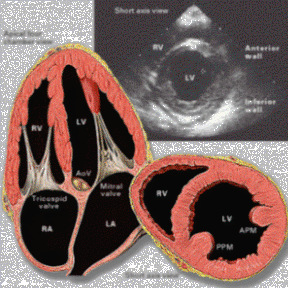
NONISCHEMIC CARDIOMYOPATHY
As noted, there are various types of cardiomyopathy. These fall into two major categories: "ischemic" and "nonischemic" cardiomyopathy.
- Ischemic cardiomyopathy typically refers to heart muscle damage that results from coronary artery disease, such as heart attack, and will not be discussed here (see page 8 on how to get information on the disorder).
- Nonischemic cardiomyopathy includes several types. The three main types are covered in this fact sheet. They are: dilated, hypertrophic, and restrictive. The name of each describes the nature of its muscle damage.
-
Dilated (Congestive) Cardiomyopathy
By far the most common type of nonischemic cardiomyopathy, the dilated (stretched) form occurs when disease-affected muscle fibers lead to enlargement, or dilation, of one or more chambers of the heart. This weakens the heart's pumping ability. The heart tries to cope with the pumping limitation by further enlarging and stretching--a process known as "compensation."
Dilated cardiomyopathy occurs most often in middle-aged people and more often in men than women. However, the disease has been diagnosed in people of all ages, including children.
In most cases, the disease is bb--a specific cause for the damage is never identified.
But some factors have been linked to the disease's occurrence. For instance, alcohol has a direct suppressant effect on the heart. Dilated cardiomyopathy can be caused by chronic, excessive consumption of alcohol, particularly in combination with dietary deficiencies. Also, dilated cardiomyopathy occasionally occurs as a complication of pregnancy and childbirth. Other factors are: various infections, mostly viral, which lead to an inflammation of the heart muscle (myocarditis); toxins (such as cobalt, once used in beers, for instance); and, rarely, heredity.