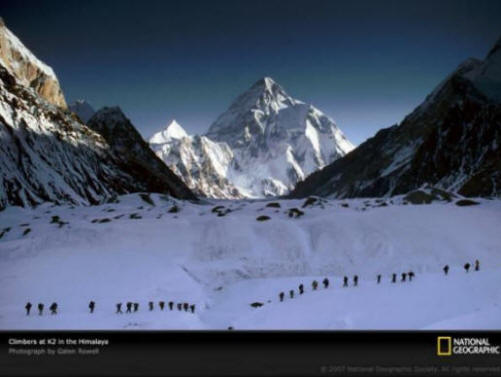
High Mountain Region
The mountain ranges include the Himalayas, the
Karakoram and the Hindukush. The Himalayas spread in the north-east and the
Karakoram rises on the north-west of the Himalayas and extends eastward up to
Gilgit. The Hindu Kush mountains lie to the north-west of the Karakoram, but
extend eastward into Afghanistan. With the assemblage of 35 giant peaks over
24,000 ft. high (7,315m), the region is the climbers' paradise. Many summits are
even higher than 26,000 ft.(7,925 m) and the highest K-2(Mt.Godwin Austin) is
exceeded only by Mt.Everest. Inhospitable and technically more difficult to
climb than even Everest, they have taken the biggest toll of human lives in the
annals of mountaineering.
The passes are rarely lower than the summit of
Mt. Blanc and several are over 18,000 ft. (5,485 m). The Karakoram Highway, that
passes through the mountains, is the highest trade route in the world. Besides,
the region abounds in vast glaciers, large lakes and green valleys which have
combined at places to produce holiday resorts such as Gilgit, Hunza and Yasin in
the west and the valleys of Chitral, Dir, Kaghan and Swat drained by rivers
Chitral, Pankkora, Kunhar and Swat respectively in the east. Dotted profusely
with scenic spots having numerous streams and rivulets, thick forests of pine
and junipers and a vast variety of fauna and flora, the Chitral, Kaghan and Swat
valleys have particularly earned the reputation of being the most enchanting
tourist resorts of Pakistan.
South of the high mountains, the ranges lose
their height gradually and settle down finally in the Margalla hills
(2,000-3,000 ft.) in the vicinity of Islamabad, the Capital of Pakistan, and
Swat and Chitral hills, north of river Kabul. Although the climate of the region
is extremely diverse, according to aspect and elevation, yet as a whole it
remains under the grip of severe cold from November to April. May, June and July
are pleasant months. The southeren slopes receive heavy rainfall and
consequently are covered with forest of deodar, pine, poplar and willow trees.
The more northerly ranges and north-facing slopes receive practically no rains
and are, therefore, without trees.
There is a considerable trans-humane from the
mountains to the plains in winter and from plains to the mountains in summer.
The permanent settlers grow corn, maize, barely, wheat and rice on the terraced
fields and also raise orchards of apples, apricots, peaches and grapes. Peaks
and Glaciers Eric Shipton, a great mountainer who perished in Pakistan's
Northern Areas, wrote in his account. To describe this region is to indulge in
superlatives, for everywhere you look are the highest, the longest and the
largest mountains, glaciers and rivers in the world.
Making some allowance for Shipton's tendency
towards slight exaggeration, born out of awe and fascination, the fact remains
that Pakistan boasts of the largest share of the highest mountain peaks in the
world. Its own highest peak, the famed and dreaded K-2, is the second highest in
the world, being just some `ropes' short of the Everest in Nepal. With due
respect to the Everest, K-2 is regarded as far more firmidable to climb than its
relatively facile superior. Three of the mightiest mountain systems- the
Hindukush, the Karakorams and the Himalayas- adorn the forehead of Pakistan. The
second highest peak of Himalayas, as also of Pakistan, is the Nanga Parbat which
literally means the "Naked Mountain".
Pakistan has seven of the 16 tallest peaks in
Asia. The statistics are simply baffling: 40 of the world's 50 highest mountains
are in Pakistan; in Baltistan over 45 peaks touch or cross the 20,000 foot mark;
in Gilgit within a radius of 65 miles, there are over two dizens peaks ranging
in height between 18,000 to 26,000 feet.
The awe-inspiring beauty provided inspiration
to a Pakistani writer to observe lyrically, "in Pakistan's lofty mountain
regions, reaching for the sky doesn't seem too ambitious". Pakistan's Eight
Thousanders: There are a total of 14 main peaks soaring above 8000 metres in the
world. Out of these, 8 are located in Nepal, 5 in Pakistan and 1 in China. It
has become prestigious to make these peaks as targets by mountaineers every
year. In fact, successful climb over these peaks is considered an enviable
measure of their attainment. By far, the largest number of mountaineering
expeditions visiting Pakistan has been coming from Japan.