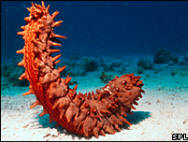
 Sea cucumbers live on the ocean floor |
Sea cucumbers could provide a potential weapon to block transmission of the malaria parasite in your body, a study suggests. The creature produces a protein, called lectin, which impairs development of the parasites.
A team genetically engineered mosquitoes that carry the malaria parasite to produce the same protein in their gut when feeding.
The Pathogens study found the protein disrupted development of the parasites inside the insects' stomach.
Malaria causes severe illness in 500 million people worldwide each year, and kills more than one million.
It is estimated that 40% of the world's population are at risk of the disease.
To stimulate the mosquitoes to produce lectin, the researchers fused part of the gene from the sea cucumber which produces the protein with a gene from the insect.
The results showed that the technique was effective against several of the parasites which cause malaria.
Lectin is poisonous to the parasites when they are still in an early stage of development called an ookinete.
Usually, the ookinetes migrate through the mosquito's stomach wall, and produce thousands of daughter cells which invade the salivary glands, and infect a human when the mosquito takes a blood meal.'
But when exposed to lectin the ookinetes are killed before they can start their deadly journey.
Work left
Researcher Professor Bob Sinden, from Imperial College London, said: "These results are very promising and show that genetically engineering mosquitoes in this way has a clear impact on the parasites' ability to multiply inside the mosquito host."
However, he said much more work still had to be done before the technique could be used to curb the spread of malaria.
"Although the sea cucumber protein significantly reduced the number of parasites in mosquitoes, it did not totally remove them from all insects.
"At the current stage of development, the genetically modified mosquitoes would remain dangerous to humans.
"Ultimately, one aim of our field is to find a way of genetically engineering mosquitoes so that the malaria parasite cannot develop inside them."
Professor Sanjeev Krishna, an expert in malaria at St George's Hospital Medical School, London, said new treatments for malaria were vital, as there was some sign that the parasites which cause the disease were developing resistance to the current artemisinin drugs.
He said: "This is a very important first step in developing a potential new way to control this infection."
Dr Ron Behrens, of the London School of Hygiene and Tropical Medicine, said the technique showed promise in theory - but he warned that introducing genetically modified mosquitoes could be fraught with practical difficulties.
"You would have to get the modified version to become the predominant species, and that has never been done in any setting before," he said.


 Ultimately, one aim of our field is to find a way of genetically engineering mosquitoes so that the malaria parasite cannot develop inside them