Congressional
Kidney
Caucus
Living
With
One
Kidney
|
|
|
The kidneys perform many
functions that are vital to
good health. It is not
unusual, however, to have
only one kidney to do the
work that two kidneys
ordinarily do.
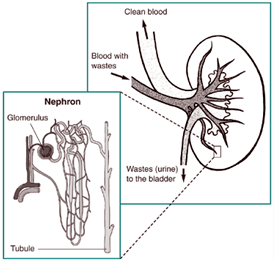
Why do people have a
single kidney?
Many people are born with a
single kidney. This occurs
in about one out of 750
people. Being born with a
single kidney is more common
in males, and the left
kidney is the one more often
absent. The ureter (the tube
that takes urine from the
kidney to the bladder) on
the affected side is usually
abnormal or absent. An
abnormality of the
reproductive tract may also
be seen on the same side.
This occurs more often in
females than in males.
In other cases, one
kidney may need to be
surgically removed, leaving
a single remaining kidney. A
kidney may need to be
removed because of an
anatomic abnormality such as
obstruction, or because of a
tumor, or from a sever
traumatic injury after an
accident. One kidney may be
donated to a loved one with
kidney failure.
How is a single kidney
different?
The single normal kidney
will grow faster and get
larger than a normally
paired kidney. For this
reason, the single kidney is
larger and heavier than
normal, and it is,
therefore, more vulnerable
to injury. It is important
to be aware of the increased
risk for injury with certain
heavy contact sports, so
that careful decisions may
be made regarding
participation in various
physical activities. The
American Academy of
Pediatrics, American Academy
of Family Physicians and the
Medical Society of Sports
Medicine have suggested that
people with one kidney avoid
sports that involve higher
risks of heavy contact or
collision. This includes
boxing, field hockey,
football, ice hockey,
Lacrosse, martial arts,
rodeo, soccer and wrestling.
Anyone with a single kidney
who decides to participate
in these sports should be
extra careful and wear
protective padding. He or
she should understand that
the consequences of losing a
single kidney are very
serious.
Are there long-term
problems for people with a
single kidney?
In general, most people with
a single normal kidney have
few or no problems,
particularly in the first
few years. However, some
longer term problems have
been recognized. Most
doctors believe that people
with a single kidney,
particularly from birth or
during early childhood
should be followed more
closely than people with two
normal kidneys. Children who
have had a kidney surgically
removed may have a slightly
increased chance of
developing abnormal amounts
of protein in the urine and
some abnormality in kidney
function by 25 years later.
Similar abnormalities have
been found in individuals
born with a single kidney.
In addition, there is
greater chance of developing
high blood pressure. The
decrease in kidney function
is usually mild, and life
span is normal.
Are dietary changes
needed?
In general, special diets
are not needed by
individuals who have one
healthy kidney. Speak to
your doctor or a registered
dietitian if you have
questions about the basic
ingredients of a healthy
diet.
How often should
someone with one kidney see
a doctor?
A urinalysis (urine test)
and blood pressure check
should be done yearly, and
kidney function should be
checked every few years, or
more often if an abnormal
urinalysis or blood pressure
is found.
What special
precautions are recommended
for transplant patients?
Because the transplanted
kidney is usually placed
into the pelvis, these
kidneys are in a location
providing less protection
and, therefore, are more
easily injured.
Consequently, the same
recommendations of avoiding
heavy contact and collision
sports apply to the people
who have had a kidney
transplant.
Careful testing has shown
that the transplanted kidney
can increase its function as
in other situations
resulting in a single
kidney, reaching a level of
function that is about 40
percent greater than a
normal level for a single
kidney.